What is Warren Buffett Net Worth is a profound question, especially when considering his illustrious career spanning decades, leaving an indelible mark on the realm of finance. Warren Buffett, undoubtedly one of the most successful investors in the history of capitalism, has woven a captivating narrative of growth, resilience, and prudent decision-making that stands as a beacon for aspiring investors.
From his humble beginnings, born in Omaha, Nebraska, in 1930, into a family that valued financial responsibility, to his rise as the ‘Oracle of Omaha,’ Warren’s journey encapsulates a quintessential American tale of rags-to-riches. His early exposure to business principles, courtesy of his father, Benjamin Buffett, played a pivotal role in shaping his astute financial acumen. Notably, his investment in his first stock, Cities Service Preferred, at the age of 11, signaled the beginning of a lifelong commitment to value investing.
The significance of Berkshire Hathaway, the iconic conglomerate Warren Buffett helmed, cannot be overstated. With a diversified portfolio that has consistently outperformed the market, Berkshire’s commitment to transparency and accountability has captivated investors worldwide. This remarkable run has yielded Warren a net worth estimated at $120 billion, a testament to the power of disciplined investing and strategic decision-making.
Warren Buffett’s Early Life Experiences and How They Shaped His Investment Philosophy: What Is Warren Buffett Net Worth

Warren Buffett, one of the most successful investors in history, has often credited his early life experiences for shaping his investment philosophy. Born in 1930 in Omaha, Nebraska, Buffett’s childhood was marked by financial struggles and successes that would later influence his views on wealth creation. In this article, we will delve into the key events from his childhood that contributed to his approach to investing.These experiences, though seemingly ordinary to some, had a profound impact on Buffett’s development as a savvy investor.
As Buffett once said, “price is what you pay, value is what you get.” This mindset, shaped by his early life, has guided him in making some of the most successful investment decisions in history.
Early Exposure to Business and Finance
Buffett’s father, Howard Buffett, was a stockbroker and a politician who instilled in his son a strong interest in business and finance. As a young boy, Warren would often help his father at the brokerages, where he was exposed to the ups and downs of the stock market. This early exposure had a profound impact on Buffett, who would later credit his father for teaching him the importance of investing for the long term.Buffett’s uncle, Fred Buffett, also played a significant role in shaping his investment philosophy.
Fred was a successful investor and entrepreneur who ran a chain of Coca-Cola bottling plants in the Midwest. He took Warren under his wing and taught him the ins and outs of the business, which laid the foundation for Buffett’s future success.
The Stock Market Crash of 1929
The stock market crash of 1929 had a profound impact on Warren Buffett’s family and ultimately shaped his investment philosophy. When Buffett was just two years old, his family suffered significant losses during the crash, which left them financially strained. However, Buffett’s father managed to bounce back from the setback, and Warren witnessed firsthand the importance of investing for the long term and riding out market fluctuations.
Dow Jones and the Stock Market
Buffett’s love affair with the stock market began at an early age. He would spend hours pouring over the Dow Jones and analyzing the prices of various stocks. This habit would eventually lead him to start his own investment club, the “The Pinewood Investors”, where he and his friends made investment decisions based on their research.
The Value Investing Principle
Buffett’s value investing approach was shaped by his early life experiences. He believed that the key to success lay in identifying undervalued companies with strong fundamentals, which could be purchased at a low price and later sold at a higher price. This approach, combined with his long-term perspective, allowed him to make some of the most successful investments in history.
Avoiding Debt and Building Wealth, What is warren buffett net worth
Buffett’s family struggled with debt during his childhood, which gave him a unique perspective on the importance of living below one’s means. He learned the value of saving and investing, rather than spending impulsively, a lesson that would serve him well throughout his life. This philosophy is reflected in his own investment approach, which emphasizes the importance of building wealth through value investing rather than speculation.
The Power of Compound Interest
Buffett’s grandfather, Ernest Buffett, a successful businessman in his own right, taught Warren the power of compound interest. He showed him how small, consistent investments could lead to significant returns over time. This concept, which Buffett later called the “Magic of Compounding,” has been a cornerstone of his investment strategy.In summary, Warren Buffett’s early life experiences had a profound impact on his investment philosophy.
From his exposure to business and finance to the stock market crash of 1929 and his family’s struggles with debt, Buffett’s early life laid the foundation for his future success. His commitment to value investing, long-term perspective, and financial literacy has made him one of the most successful investors in history.
Berkshire Hathaway’s Rise to Success
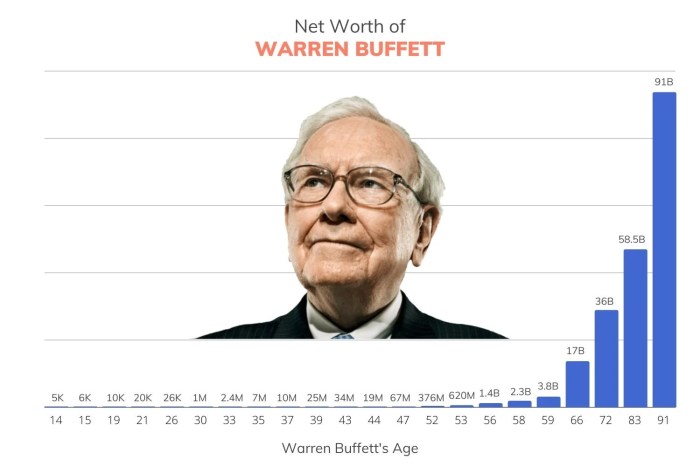
Warren Buffett’s extraordinary career at the helm of Berkshire Hathaway has spanned several decades, during which the company has grown from a struggling textile mill into a multinational conglomerate with a market capitalization exceeding $500 billion. Berkshire’s remarkable journey is a testament to Buffett’s savvy investment strategies, unwavering commitment to transparency, and his ability to navigate the complexities of the financial markets.
Transformation from Textile Mill to Conglomerate
In 1965, Buffett acquired a controlling stake in Berkshire Hathaway, then a small textile mill in Rhode Island. Under his leadership, the company began to diversify its operations, investing in a range of industries including insurance, manufacturing, retail, and more. This strategic shift enabled Berkshire to ride the waves of economic growth and downturns, leveraging its diverse portfolio to deliver exceptional returns to shareholders.
As the company’s market capitalization soared, so did its status as a leading global player in the business world.
Key Milestones in Berkshire’s History
-
Berkshire’s Initial Public Offering (IPO) in 1996: This marked a significant turning point in the company’s history, providing Buffett with the necessary capital to execute his investment strategies and further expand the company’s reach.
-
Acquisition of GEICO Insurance in 1996: This strategic move enabled Berkshire to tap into the insurance industry, which has since become a significant contributor to the company’s revenue and profits.
-
Acquisition of BNSF Railway in 2010: Berkshire’s purchase of the iconic railroad company marked a new chapter in the company’s history, as it further diversified its operations and expanded its presence in the transportation sector.
-
The company’s commitment to transparency and accountability: Under Buffett’s leadership, Berkshire Hathaway has consistently prioritized transparency and accountability in its financial reporting and business practices.
Buffett’s Value Investing Approach: The Key to Berkshire’s Success
At the heart of Berkshire’s success lies Buffett’s value investing approach, which involves identifying undervalued companies and investing in them with the expectation of long-term growth. This approach has enabled the company to navigate market fluctuations and generate exceptional returns for shareholders.
“Price is what you pay. Value is what you get.”
Transparency and Accountability: A Cornerstone of Berkshire’s Business Practices
-
Berkshire’s Annual Shareholder Letters: Each year, Buffett publishes a comprehensive letter to shareholders, providing a detailed account of the company’s performance, challenges faced, and strategic initiatives. This commitment to transparency has earned the company a reputation for accountability and trustworthiness.
-
Berkshire’s Financial Reporting: The company’s financial reports are renowned for their clarity and comprehensiveness, providing stakeholders with a thorough understanding of the company’s operations, assets, and liabilities.
The Impact of Berkshire’s Commitment to Transparency and Accountability
Berkshire’s unwavering commitment to transparency and accountability has fostered a culture of trust and respect among its stakeholders. As a result, the company enjoys a strong reputation among investors, customers, and partners, which has contributed significantly to its long-term success.
FAQ Corner
What is the primary driver of Warren Buffett’s investment success?
Value investing, a strategy Warren Buffett champions, involves identifying companies with a margin of safety, enabling them to ride out market fluctuations and ultimately realize superior returns.
Which milestone marked a significant turning point in Warren Buffett’s career?
The acquisition of Berkshire Hathaway in 1965 marked a pivotal moment in Warren Buffett’s career, setting the stage for the conglomerate’s growth into the multinational empire we know today.
What sets Warren Buffett apart from other successful investors?
Warren Buffett’s unique blend of business acumen, value investing philosophy, and commitment to transparency has earned him a reputation as a respected and trusted authority in the world of finance.
How does Warren Buffett approach risk management in his investments?
Warren Buffett’s risk management strategy prioritizes a margin of safety, which involves investing in companies with a strong financial foundation, diverse revenue streams, and a history of resilience during economic downturns.
What role does Berkshire Hathaway play in Warren Buffett’s investment strategy?
Berkshire Hathaway serves as a diversified holding company, enabling Warren Buffett to invest in a variety of assets, including stocks, bonds, real estate, and other businesses, further amplifying his net worth.
