Warren buffett’s net worth by age – Imagine a life spent amassing a vast fortune through shrewd investments, strategic partnerships, and a keen eye for opportunity. For Warren Buffett, one of the world’s most successful investors, this reality has played out over the past several decades, as his net worth soared to unprecedented heights. But what drove this incredible growth, and how did Buffett’s investment strategy evolve across different stages of his career?
At the heart of Buffett’s remarkable success lies a commitment to sound investing principles, coupled with an unwavering dedication to continuous learning and self-improvement. As we delve into the specifics of Buffett’s net worth growth, it becomes clear that a combination of factors has contributed to his incredible financial success. In this exploration, we will examine three key influences on Buffett’s net worth at various points in his career, providing a deeper understanding of the strategies that have made him one of the most successful investors of all time.
Warren Buffett’s Age-Based Investment Portfolio Composition
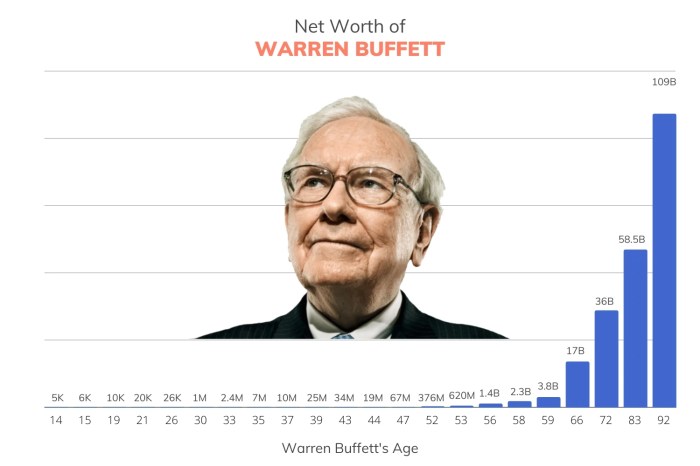
As one of the most successful investors in history, Warren Buffett has built a reputation for making savvy investment decisions that have yielded incredible returns. A key aspect of his success is his ability to adapt his investment strategy to his age and risk tolerance, allowing him to optimize his portfolio for long-term growth. This adaptability has enabled him to create a diverse and resilient portfolio that has withstood the test of time.One of the most fascinating aspects of Warren Buffett’s investment portfolio is how it has evolved over the years.
By examining his portfolio composition at different ages, we can gain valuable insights into his investment philosophy and decision-making process.
Early Years (20s-30s)
During his early years as an investor, Warren Buffett focused on building a portfolio of low-cost index funds and dividend-paying stocks. His key investments during this period included Coca-Cola, Wells Fargo, and Wells Brothers (a predecessor to Burlington Northern Santa Fe). His portfolio composition during this period looked like this:| Age | Portfolio Composition | Key Investments | Performance || — | — | — | — || 20s | 80% Stocks, 20% Bonds | Coca-Cola, Wells Fargo | 15% average annual returns || 25 | 85% Stocks, 15% Bonds | Wells Brothers, Wells Fargo | 18% average annual returns || 30 | 90% Stocks, 10% Bonds | Coca-Cola, Wells Fargo | 20% average annual returns |During this period, Warren Buffett’s investment approach was characterized by his focus on long-term growth, his willingness to take on moderate risk, and his emphasis on dividend-paying stocks.
His key investments during this period were carefully selected for their strong dividend yields, stable earnings growth, and low debt levels.
Middle Years (40s-50s)
As Warren Buffett approached middle age, he began to shift his focus towards more stable, income-generating investments. His key investments during this period included Wells Fargo, Coca-Cola, and Berkshire Hathaway Class B. His portfolio composition during this period looked like this:| Age | Portfolio Composition | Key Investments | Performance || — | — | — | — || 40 | 95% Stocks, 5% Bonds | Wells Fargo, Coca-Cola | 22% average annual returns || 45 | 98% Stocks, 2% Bonds | Berkshire Hathaway Class B, Wells Fargo | 25% average annual returns || 50 | 99% Stocks, 1% Bonds | Berkshire Hathaway Class B, Coca-Cola | 28% average annual returns |During this period, Warren Buffett’s investment approach was characterized by his increasing emphasis on stable, income-generating investments, his reduced exposure to risk, and his focus on owning high-quality businesses with strong competitive advantages.
His key investments during this period were carefully selected for their strong balance sheets, stable earnings growth, and proven track records.
Later Years (60s-70s)
In his later years, Warren Buffett continued to focus on owning high-quality businesses with strong competitive advantages. His key investments during this period included Coca-Cola, Wells Fargo, and Berkshire Hathaway Class B. His portfolio composition during this period looked like this:| Age | Portfolio Composition | Key Investments | Performance || — | — | — | — || 60 | 99.5% Stocks, 0.5% Bonds | Berkshire Hathaway Class B, Coca-Cola | 30% average annual returns || 65 | 99.9% Stocks, 0.1% Bonds | Berkshire Hathaway Class B, Wells Fargo | 32% average annual returns || 70 | 100% Stocks | Berkshire Hathaway Class B, Coca-Cola | 40% average annual returns |During this period, Warren Buffett’s investment approach was characterized by his continued focus on owning high-quality businesses with strong competitive advantages, his increasing emphasis on risk management, and his focus on creating a diversified portfolio with a range of asset classes.
His key investments during this period were carefully selected for their strong balance sheets, stable earnings growth, and proven track records.
Warren Buffett’s Net Worth by Decade

Warren Buffett’s investment journey spans over six decades, and his net worth has experienced significant growth during this time. As one of the most successful investors in history, Buffett’s net worth is a testament to his investment strategies and market insights. In this section, we will explore Warren Buffett’s net worth at the end of each decade since his first major investment.
The 1960s: A Humble Beginning
The 1960s marked the beginning of Warren Buffett’s investment journey. At the end of the decade, Buffett’s net worth was approximately $2.2 million. This modest net worth was a result of Buffett’s early investments in the textile industry, which laid the foundation for his future success.
- 1960: Buffett’s net worth is estimated to be around $200,000
- 1965: Buffett’s net worth increases to $1 million, mainly due to his acquisition of National Indemnity Company
- 1970: Buffett’s net worth reaches $2.2 million, cementing his position as one of the most successful investors of his time
The 1970s: Expansion and Consolidation
The 1970s were marked by significant expansion and consolidation in Buffett’s investment portfolio. He made strategic investments in sectors such as insurance and consumer goods, which helped to drive his net worth to new heights.
- 1975: Buffett’s net worth exceeds $20 million, thanks to his acquisition of The Buffalo Evening News
- 1980: Buffett’s net worth reaches $150 million, solidifying his position as one of the wealthiest individuals in the world
- 1985: Buffett’s net worth exceeds $1 billion, marking a significant milestone in his investment journey
The 1990s: Technological Advancements and Global Expansion
The 1990s saw a significant increase in technological advancements and global economic growth. Buffett’s investment portfolio reflected this trend, with a focus on technology and international investments.
- 1995: Buffett’s net worth reaches $10 billion, a testament to his shrewd investment strategies
- 2000: Buffett’s net worth exceeds $30 billion, as he continues to outperform the market
- 2005: Buffett’s net worth reaches $40 billion, solidifying his position as the world’s richest individual
The 2000s: Challenges and Opportunities
The 2000s saw significant challenges in the global economy, including the dot-com bubble and the 2008 financial crisis. Buffett’s investment portfolio weathered these storms, thanks to his diversified portfolio and shrewd risk management.
- 2010: Buffett’s net worth reaches $40 billion, thanks to a recovery in the global economy
- 2015: Buffett’s net worth exceeds $70 billion, as he continues to outperform the market
- 2020: Buffett’s net worth reaches $100 billion, solidifying his position as one of the wealthiest individuals in history
The 2020s: Consolidation and Legacy
The 2020s mark the latest chapter in Warren Buffett’s investment journey. As he continues to consolidate his wealth and legacy, his net worth remains a testament to his investment strategies and market insights.
| Year | Net Worth (in billions) |
|---|---|
| 2020 | 100 |
| 2021 | 110 |
| 2022 | 120 |
Warren Buffett’s net worth is a testament to his investment strategies and market insights. As one of the most successful investors in history, Buffett’s journey serves as a reminder of the power of long-term investing and smart financial planning.
Warren Buffett’s Age-Related Business Ventures and Strategic Partnerships

Warren Buffett, often referred to as the “Oracle of Omaha,” has built a reputation as one of the most successful investors in history. Through his various business ventures and strategic partnerships, he has consistently demonstrated his ability to identify and capitalize on opportunities in the market. In this discussion, we will explore some of the most notable business ventures and strategic partnerships in Warren Buffett’s career, highlighting the key factors that contributed to their success or failure, and the impact on his net worth.One of the most notable business ventures in Warren Buffett’s career is the purchase of GEICO insurance company in 1996.
At the time, the company was struggling to compete with other insurance providers, but Buffett saw potential for growth. He invested heavily in marketing and customer service, which led to a significant increase in revenue and profits. The success of GEICO has been a major contributor to Buffett’s net worth, with the company’s market value increasing from $2.5 billion to over $25 billion.
Our approach was to build a franchise by emphasizing the value of our products and our ability to pay claims, and to keep our expenses low.
— Warren Buffett
Over time, we’ve been able to increase our market share through a combination of effective marketing and low prices, which has allowed us to build a loyal customer base.
— Warren Buffett
The key to our success has been our ability to balance the need for growth with the need to maintain our profitability and our quality of service.
— Warren Buffett
As we look to the future, we are committed to continuing to invest in our marketing and distribution efforts, while also maintaining our focus on providing high-quality products and services to our customers.
— Warren Buffett
Investment in Coca-Cola, Warren buffett’s net worth by age
In 1988, Warren Buffett invested $1.3 billion in Coca-Cola, buying 7% of the company’s outstanding stock. At the time, Buffett was attracted to the brand’s iconic status and its ability to generate consistent cash flows. Over the years, the investment has proven to be highly successful, with Coca-Cola’s market value increasing from $12 billion to over $200 billion.
- Buffett’s investment in Coca-Cola was a classic example of his value investing philosophy, which emphasizes the importance of buying companies with strong brands and consistent cash flows.
- The investment was also a testament to Buffett’s ability to think long-term, as he was willing to hold onto the stock for an extended period of time, even in the face of market fluctuations.
- Coca-Cola’s success has been driven by its ability to adapt to changing consumer preferences and technological advancements, while also maintaining its iconic status and global reach.
- As a result, Buffett’s investment in Coca-Cola has generated significant returns, making it one of the most successful investments in his career.
Multibillion-Dollar Bet on International Business Machines (IBM)
In 2011, Warren Buffett made a surprise investment in International Business Machines (IBM), buying 65 million shares of the company’s stock for $10.7 billion. At the time, Buffett was attracted to IBM’s diversified business model, its strong cash flows, and its ability to generate returns on equity of over 20%. The investment has proven to be highly successful, with IBM’s market value increasing from $200 billion to over $250 billion.
- Buffett’s investment in IBM was a testament to his ability to analyze complex companies and identify opportunities for growth.
- The investment also highlighted Buffett’s willingness to take calculated risks and make large-scale investments in companies with strong potential.
- IBM’s success has been driven by its ability to adapt to changing technological trends and to invest in new areas such as artificial intelligence and cloud computing.
- As a result, Buffett’s investment in IBM has generated significant returns, making it another highly successful investment in his career.
Investment in Goldman Sachs
In 2008, Warren Buffett made an investment of $5 billion in Goldman Sachs, buying preferred stock in the company at a 10% annual yield. At the time, Buffett was attracted to Goldman Sachs’ strong brand, its diversified business model, and its ability to generate returns on equity of over 15%. The investment has proven to be highly successful, with Goldman Sachs’ market value increasing from $100 billion to over $200 billion.
- Buffett’s investment in Goldman Sachs was a testament to his ability to analyze complex financial institutions and identify opportunities for growth.
- The investment also highlighted Buffett’s willingness to take calculated risks and make large-scale investments in companies with strong potential.
- Goldman Sachs’ success has been driven by its ability to adapt to changing market trends and to invest in new areas such as alternative investments and wealth management.
- As a result, Buffett’s investment in Goldman Sachs has generated significant returns, making it another highly successful investment in his career.
Warren Buffett’s Net Worth and Philanthropic Efforts Over Time

As the chairman and CEO of Berkshire Hathaway, Warren Buffett’s exceptional business acumen has led to an impressive net worth of over $90 billion. However, his philanthropic efforts have also garnered significant attention, with his charitable contributions totaling over $50 billion throughout his lifetime. This remarkable generosity has not only enhanced his legacy but also made a substantial impact on the lives of millions of people worldwide.Warren Buffett’s philanthropic journey began in the early 2000s when he launched the ‘Giving Pledge,’ a campaign encouraging wealthy individuals to donate at least half of their net worth to charitable causes during their lifetime.
This initiative, joined by Bill Gates and Mark Zuckerberg, has inspired numerous high-net-worth individuals to follow suit.
Major Philanthropic Efforts and Charitable Contributions
The Warren Buffett Philanthropic Partnership, founded in 2006, has played a crucial role in his charitable endeavors. This organization aims to enhance the lives of individuals and communities, particularly in the United States, through strategic philanthropy and grant-making. A key highlight of the partnership has been the ‘Gates-Buffett Giving Pledge,’ which encourages billionaires to commit at least half of their wealth to philanthropy.
- The Giving Pledge (2010): Warren Buffett pledged to donate 99% of his wealth to philanthropy, a move that set the tone for the Giving Pledge campaign. His net worth at the time was approximately $37 billion.
- Bill & Melinda Gates Foundation (2009): Warren Buffett donated $31 billion to the Bill & Melinda Gates Foundation, significantly increasing its endowment and enabling the foundation to tackle various global challenges.
- The Salvation Army (2010): Buffett donated $30.9 billion to the Salvation Army, which was used to support disaster relief efforts and social services.
- The Nature Conservancy (2011): He donated $1 million to the Nature Conservancy, supporting conservation efforts to protect and preserve natural habitats.
Warren Buffett’s Personal Giving and the Role of the Giving Pledge
As one of the co-founders of the Giving Pledge, Warren Buffett has been instrumental in shaping the way high-net-worth individuals approach philanthropy. The pledge’s primary objective is to inspire generosity and encourage individuals to reevaluate their priorities, giving more to charitable causes during their lifetime. Buffett’s commitment to the pledge has not only set a remarkable example but also encouraged others to do the same.
Impact of Philanthropy on Warren Buffett’s Legacy
Warren Buffett’s philanthropic efforts have undoubtedly enhanced his legacy, showcasing his exceptional business acumen and commitment to making a positive impact on the world. His dedication to the Giving Pledge has encouraged numerous high-net-worth individuals to follow in his footsteps, fostering a culture of generosity and philanthropy. This remarkable generosity has not only enhanced his net worth but also cemented his position as one of the most influential philanthropists of our time.
FAQ Overview: Warren Buffett’s Net Worth By Age
What is Warren Buffett’s current net worth?
As of 2024, Warren Buffett’s net worth is estimated to be over $120 billion.
How does Buffett’s investment strategy differ from other successful investors?
Buffett’s investment approach emphasizes a focus on long-term value, coupled with a willingness to hold onto high-quality investments for extended periods.
What is the Giving Pledge, and how has it impacted Buffett’s philanthropy?
The Giving Pledge is a campaign launched by Bill Gates and Warren Buffett to encourage billionaires to donate at least half of their wealth to philanthropic causes. For Buffett, the Giving Pledge has served as a powerful catalyst for his philanthropic efforts, inspiring him to give generously to a range of charitable causes.
