In the realm of finance, a select group of individuals has captured the imagination of the world with their extraordinary wealth and influence. The net worth billionaires, with their immense financial power, have become major players shaping global markets, and their impact cannot be overstated. From shaping tax policies to making strategic investments, and from philanthropy to policy changes, these billionaires are leaving an indelible mark on the world.
As we delve deeper into the world of net worth billionaires, it becomes increasingly clear that their influence extends far beyond their financial portfolios. Their investment strategies, risk management approaches, and philanthropic efforts have all contributed significantly to their remarkable success, and by studying their approaches, we can gain valuable insights into the complexities of wealth and finance.
A closer examination of the net worth of billionaires and its correlation with financial market trends
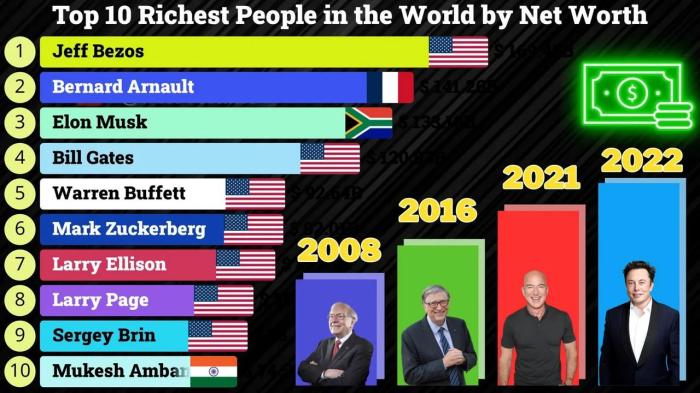
Billionaires have always been a subject of fascination, with their vast wealth and influence on global markets. However, have you ever wondered how their net worth fluctuates in response to global economic shifts? In this examination, we’ll delve into the historical fluctuations of billionaires’ net worth, compare their worth across different nations, and explore industry-specific trends that have positively impacted their fortunes.Historical fluctuations in the net worth of billionaires in response to global economic shifts have been significant.
For instance, during the 2008 financial crisis, the net worth of billionaires plummeted by 28% in a single year, from $3.1 trillion in 2007 to $2.2 trillion in 2008, according to the Hurun Global Rich List. This decline can be attributed to the collapse of the subprime mortgage market, which led to a global recession.In contrast, the COVID-19 pandemic led to a surge in the net worth of billionaires, with their collective wealth increasing by 24% in 2020, to $10.2 trillion, as reported by the Bloomberg Billionaires Index.
This growth was largely driven by the rise of technological companies, such as Amazon, Microsoft, and Alphabet (Google’s parent company), which saw significant increases in their share prices.
Comparison of net worth of billionaires across different nations
The distribution of billionaires’ net worth across different nations is also noteworthy. According to a report by Credit Suisse, the United States has historically had the largest share of billionaires’ net worth, accounting for approximately 45% of the global total in 2020. In contrast, China had the second-largest share, with 21% of the global total, followed by India with 6%.
- United States: The net worth of US billionaires was $4.6 trillion in 2020, with Jeff Bezos topping the list with an estimated net worth of $207 billion.
- China: China’s billionaires saw their net worth increase by 25% in 2020, to $2.1 trillion, with Jack Ma (Alibaba Group founder) being the richest, with an estimated net worth of $62 billion.
- India: India’s billionaires saw a 32% increase in their net worth in 2020, to $630 billion, with Mukesh Ambani (Reliance Industries Limited) being the richest, with an estimated net worth of $85 billion.
Industry-specific trends that have positively impacted the net worth of billionaires
The rise of e-commerce, in particular, has had a profound impact on the net worth of billionaires in the 2020s. Companies like Amazon, Alibaba, and JD.com have seen significant increases in their share prices, driving up the net worth of their founders and investors. For example, Jeff Bezos, the founder of Amazon, saw his net worth increase by 75% in 2020, to $207 billion, as the COVID-19 pandemic fueled the growth of e-commerce.
According to a report by McKinsey, the global e-commerce market grew by 14% in 2020, to $4.9 trillion, driven by the increased demand for online shopping during the pandemic.
| Company | Industry | Net Worth Increase |
|---|---|---|
| Amazon | E-commerce | 75% |
| Alibaba Group | E-commerce | 55% |
| JD.com | E-commerce | 60% |
An in-depth examination of the personal and financial circumstances of billionaires who have faced financial setbacks or personal crises

As we delve into the world of billionaires, it’s natural to assume that these individuals have it all – wealth, power, and prestige. However, behind the glitz and glamour, many billionaires have faced significant financial setbacks and personal crises. This phenomenon highlights the complexities of wealth accumulation and management, underscoring the need for a nuanced understanding of the factors that contribute to financial success and failure.These billionaires’ stories serve as a fascinating case study, offering valuable insights into the intricacies of wealth psychology, risk management, and personal resilience.
By examining the lives of a few notable billionaires who have navigated financial difficulties, we can distill key takeaways that can benefit individuals and households seeking to safeguard their own financial well-being.
Biographies of Billionaires who Have Exceeded Setbacks, Net worth billionaires
-
Milton Hershey: Founder of the iconic chocolate company Hershey’s, Milton Hershey’s rags-to-riches story is a testament to perseverance and risk-taking. Initially, he experienced financial difficulties, working multiple jobs to support himself. However, after partnering with a former business partner, Hershey’s fortunes turned, and he became one of America’s wealthiest entrepreneurs.
- Hershey’s setbacks were largely due to his early struggles to establish his confectionery business.
- His focus on innovation and customer satisfaction ultimately led to his company’s success.
- Hershey’s ability to adapt and learn from his mistakes paved the way for his eventual triumph.
- Ted Turner: The charismatic CNN founder faced significant financial setbacks, including bankruptcy, at the age of 32. This experience served as a turning point in his life, prompting him to redirect his focus towards building his media empire. Turner’s determination and strategic business decisions enabled him to rise from the ashes and become one of the most influential media moguls of our time.
- Ted Turner’s financial setbacks stemmed from overexpansion and poor management of his first business ventures.
- His ability to pivot and focus on a new opportunity – starting a 24-hour news channel – ultimately led to his success.
- Turner’s resilience in the face of adversity serves as a powerful example of the importance of learning from failure.
- W. Clement Stone: A pioneer in the insurance industry, W. Clement Stone’s story is a prime example of the power of wealth psychology and the significance of cultivating a positive mental state. Despite facing significant financial challenges, Stone attributed his success to his optimistic outlook and his commitment to personal development.
- Stone’s setbacks stemmed from the early struggles of building his insurance business.
- His focus on self-improvement and cultivating a positive mindset enabled him to overcome adversity and achieve significant success.
- The concept of wealth psychology, as exemplified by Stone, highlights the interplay between mental and financial well-being.
The Key Factors Contributing to Setbacks in Billionaires’ Lives
While each of the aforementioned billionaires has a unique story, several common factors contributed to their setbacks, including: Familly Dynamics
- Family ties can be a double-edged sword, often providing emotional support but also creating conflicts of interest and distractions.
- Billionaires with strong family ties may face challenges when navigating business decisions and allocating resources between family members and their own ventures.
Business Decisions
- Poor management, overexpansion, and misallocation of resources can all lead to financial setbacks in any business, regardless of its size or scope.
- Billionaires who focus on innovation, strategic decision-making, and adaptability tend to be more successful in the long run.
Personal Habits
- Billionaires often prioritize their personal lives, with some experiencing mental health issues, addiction, or other personal struggles that can impact their business acumen.
- Cultivating a positive mental state, prioritizing self-improvement, and maintaining a work-life balance can contribute to long-term success.
Lessons for Non-Billionaires: Wealth Psychology, Risk Management, and Personal Resilience
The biographies of these billionaires provide valuable takeaways for individuals seeking to ensure financial stability and navigate the complexities of wealth management. By understanding the interplay between mental and financial well-being, one can better appreciate the importance of cultivating a positive mindset, prioritizing self-improvement, and managing risks effectively. By incorporating these lessons into their own lives, individuals can increase their chances of achieving long-term financial success and navigating life’s inevitable setbacks.
Expert Answers: Net Worth Billionaires
Q: What is the primary driver of a billionaire’s net worth?
A: A billionaire’s net worth is primarily driven by their strategic investments, risk management approaches, and savvy business decisions.
Q: How do net worth billionaires use their wealth to shape policy changes?
A: Net worth billionaires use their wealth to shape policy changes by lobbying governments, funding advocacy groups, and leveraging their influence to shape legislation and regulations.
Q: What are some common characteristics of successful net worth billionaires?
A: Successful net worth billionaires often possess qualities such as strategic thinking, risk tolerance, and a willingness to adapt to changing market conditions.
Q: How do net worth billionaires manage risk and mitigate losses?
A: Net worth billionaires use various risk management strategies, such as diversification, hedging, and asset allocation, to mitigate losses and optimize their investments.
