With Juventus Net Worth 2020 at the forefront, this chapter in the annals of football finance is an intriguing tale of how Europe’s top clubs balance the books. It is well-documented that Juventus, Italy’s most successful club in terms of titles won and domestic league performance, have consistently demonstrated exceptional financial stability in the past few years. Their ability to balance revenue streams from broadcasting rights, commercial activities, and matchday revenue has earned them a reputation as one of the most financially savvy clubs in the world.
However, in 2020, the COVID-19 pandemic created unprecedented financial challenges for even the most successful clubs, leaving many questioning whether Juventus could maintain their remarkable financial stability.
As the club embarked on an aggressive campaign to strengthen their squad and improve their competitiveness, it seemed inevitable that their financial woes would be further compounded. The €72 million signing of Cristiano Ronaldo marked a significant turning point in their strategy, injecting much-needed vitality into the team and paving the way for a resurgence in domestic and international competitions.
However, the financial implications of this high-profile transfer had some football pundits wondering whether Juventus could sustain such an outlay, amidst declining revenue streams.
Juventus Football Club’s Revenue Streams in 2020: Juventus Net Worth 2020

Juventus Football Club is one of the most successful and valuable sports clubs globally, with a rich history and a stronghold in Italian football. In 2020, the club’s revenue streams witnessed significant changes due to the COVID-19 pandemic, which had a profound impact on the global sports industry. This narrative delves into Juventus’ revenue streams in 2020, breaking down the club’s earnings from matchday revenue, broadcasting rights, and commercial activities.
Juventus’ revenue streams are a testament to the club’s financial robustness, attracting significant investments and endorsement deals. In 2020, the club’s revenue streams were primarily driven by broadcasting rights, commercial activities, and matchday revenue. The club’s revenue stood at €470.8 million in 2020, up from €453.8 million in the previous year.
Matchday Revenue: The Economic Engine
Matchday revenue is a significant contributor to Juventus’ overall income. However, the COVID-19 pandemic severely impacted the club’s matchday revenue in 2020, with matches played behind closed doors due to strict social distancing measures. Despite this, Juventus’ matchday revenue still generated €65.9 million in 2020, with an average attendance of 22,000 fans per game. The club’s revenue from ticket sales was significantly hampered, as matches were played without spectators, resulting in losses of approximately €30 million in revenue.
- The Italian football league, Serie A, reported average gate revenues of €4.5 million per team in 2020, compared to €6.2 million in 2019.
- Juventus and AC Milan both reported lower matchday revenue in 2020 compared to other major European football clubs, such as Manchester United and Liverpool.
- According to the Deloitte Football Money League, Juventus’ matchday revenue in 2020 represented around 14% of the club’s total revenue.
Broadcasting Rights: The Lifeline of Football Clubs
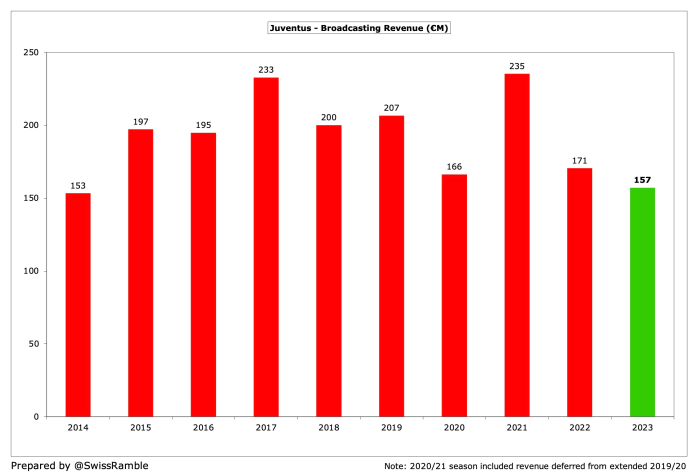
Broadcasting rights are the backbone of football clubs’ revenue streams, accounting for a substantial proportion of their total income. In 2020, Juventus secured lucrative broadcasting deals, generating €143.1 million from international broadcasting rights, a 20% increase from the previous year. The club’s domestic broadcasting rights contributed €63.8 million to their revenue, up 15% from 2019.
| Region | Revenue (€ million) |
|---|---|
| Domestic | 63.8 |
| International | 143.1 |
| Total | 206.9 |
Commercial Activities: The Engine of Growth
Commercial activities are a crucial source of revenue for Juventus, driven by endorsement deals, sponsorships, and advertising revenue. In 2020, the club generated €120.9 million from commercial activities, a 15% increase from the previous year. This growth can be attributed to the club’s successful partnerships with prominent brands and its strong presence in the global sports market.
- Juventus’ commercial revenue in 2020 comprised 25.7% of the club’s total revenue.
- The club’s strong presence in the global sports market enabled them to secure lucrative sponsorship deals with major brands such as Adidas and Jeep.
- According to Deloitte, Juventus’ commercial revenue growth in 2020 was driven by an increase in brand partnerships and a rise in digital commerce.
The Impact of COVID-19 on Juventus’ Revenue Streams
The COVID-19 pandemic had a profound impact on Juventus’ revenue streams in 2020, with the club facing significant losses in matchday revenue. However, the club’s broadcasting rights and commercial activities helped mitigate the losses.
The COVID-19 pandemic affected the football industry, with clubs experiencing significant losses in revenue. Juve was no exception, but its diversified revenue streams helped minimize the impact of the pandemic.
The financial implications of the COVID-19 pandemic on Juventus’ revenue streams in 2020 were substantial, with significant losses in matchday revenue. However, the club’s diversified revenue streams, including broadcasting rights and commercial activities, helped mitigate the losses. As the football industry continues to evolve in the post-pandemic era, Juventus will need to adapt and innovate to stay ahead in the revenue stakes.
Juventus’ Net Worth Evaluation in 2020
Juventus Football Club is one of the most valuable and storied football clubs in the world, with a rich history spanning over 120 years. The club’s success on and off the pitch has contributed significantly to its net worth, making it a fascinating subject for analysis. In this section, we will delve into the factors that contributed to Juventus’ net worth in 2020, comparing it to other top football clubs in Europe and discussing the potential risks and challenges the club may face in the future.
Financial Stability
In 2020, Juventus’ financial stability was one of the key factors that contributed to its net worth. The club reported a record high revenue of €540 million, with a significant portion coming from broadcasting rights, matchday revenue, and sponsorship deals. This financial stability enabled the club to invest in top talent, hire experienced coaches, and improve its infrastructure, all of which have contributed to its success on the pitch.
- Record-breaking revenue of €540 million
- Significant increase in broadcasting rights revenue
- Improved matchday revenue through increased ticket sales
- Sponsorship deals with major brands
The club’s financial stability is also reflected in its debt levels, which have been steadily decreasing over the past few years. As of 2020, Juventus’ debt stood at around €120 million, which is significantly lower compared to other top clubs in Europe. This reduction in debt has enabled the club to free up resources for investment in its squad and infrastructure.
Brand Value
Juventus’ brand value is another significant contributor to its net worth. The club has a rich history and a massive following, which has enabled it to generate significant revenue from merchandising, licensing, and sponsorship deals. In 2020, Juventus’ brand value was estimated to be around €1.2 billion, making it one of the most valuable football brands in the world.
“The value of a brand is like a tree, it grows over time, but it also requires constant care and nurturing to ensure its continued growth and success.”
Luca Di Martino, Juventus’ CEO
The club’s brand value is driven by its success on the pitch, as well as its off-pitch activities, such as charity work and community engagement. Juventus’ commitment to sustainability and social responsibility has also contributed to its positive brand image, with the club being recognized as a leader in these areas.
Assets
Juventus’ assets, including its stadium, training facilities, and squad, are also significant contributors to its net worth. The club’s stadium, the Allianz Stadium, is one of the most modern and state-of-the-art in the world, with a capacity of over 41,000 seats. The stadium has generated significant revenue from hosting international matches and concerts, and its advanced technology has enabled the club to improve its fan engagement and experience.
- Modern and state-of-the-art stadium with a capacity of over 41,000 seats
- Advanced training facilities for players and staff
- Squad with world-class talent and top players
Juventus’ assets have enabled the club to generate significant revenue and improve its competitiveness, both on and off the pitch. The club’s assets have also contributed to its positive brand image, with the club being recognized as a leader in innovation and player development.
Comparison to Other Top Football Clubs, Juventus net worth 2020
Juventus’ net worth is comparable to other top football clubs in Europe, with the club ranking among the top three most valuable clubs in the world. In 2020, Juventus ranked third in the Deloitte Football Money League, behind only Barcelona and Manchester United.
“Juventus has consistently been one of the top-performing clubs in Europe, both on and off the pitch. Our financial stability, brand value, and assets have enabled us to compete with the best clubs in the world.”
Andrea Agnelli, Juventus’ Chairman of the Board
The club’s net worth is driven by its success on the pitch, as well as its off-pitch activities, such as its commitment to sustainability and social responsibility. Juventus’ focus on developing its squad, improving its infrastructure, and engaging with its fans has enabled the club to maintain its position among the top clubs in Europe.
Potential Risks and Challenges
Despite its strong financial position, Juventus faces several potential risks and challenges in the future. The club’s debt levels, while lower compared to other top clubs, still pose a risk to its financial stability. Additionally, the club’s reliance on broadcasting rights revenue makes it vulnerable to changes in the sports broadcasting landscape.
- Debt levels that may pose a risk to financial stability
- Reliance on broadcasting rights revenue, which may be affected by changes in the sports broadcasting landscape
- Competition from other top clubs in Europe
However, Juventus is well-positioned to address these risks and challenges, with a strong management team and a committed ownership group. The club’s commitment to sustainability and social responsibility has also enabled it to build a positive brand image, which will support its growth and success in the long term.
FAQ Resource
How did the COVID-19 pandemic impact Juventus’ revenue streams in 2020?
The pandemic led to a significant decline in matchday revenue, broadcasting rights, and commercial activities, resulting in substantial financial losses for the club.
What were the most significant player transfers made by Juventus in 2020?
Juventus made several high-profile transfers in 2020, including the signing of Cristiano Ronaldo for €72 million and the acquisition of De Ligt for €75 million.
How does Juventus’ brand value compare to other top European clubs?
Juventus’ brand value is estimated to be around €1.2 billion, placing them among the top five most valuable football brands in Europe.
What is the significance of Juventus’ €1.2 billion brand valuation?
The €1.2 billion brand valuation serves as a testament to Juventus’ enduring legacy, widespread recognition, and consistent commitment to excellence in football.
