Average 401k for 60 year old sets the stage for a crucial examination of retirement readiness, highlighting the importance of strategic planning for a comfortable golden years. As the baby boomer generation continues to navigate their post-work lives, the financial implications of insufficient retirement savings have never been more pressing. According to the Employee Benefit Research Institute, the average 401k balance for a 60-year-old has experienced a significant increase over the past few decades, reaching a median balance of $120,000 in 2022.
However, this figure masks the stark variations in retirement readiness, with some individuals facing an uncertain future due to inadequate savings.
The current average 401k balance for a 60-year-old is a reflection of a complex interplay between employer-sponsored retirement plans, individual financial behavior, and changes in retirement savings policies over time. While employer matching contributions, employee saving rates, and investment choices have all played a significant role in shaping the average 401k balance, the need for a diversified income stream and careful long-term care planning cannot be overstated.
In this narrative, we will delve into the factors influencing the average 401k balance at age 60, explore the importance of multiple income sources in retirement, and discuss investing strategies for maximizing 401k balances in the final years of a working career.
Average 401k Balance for a 60-year-old in the United States Today
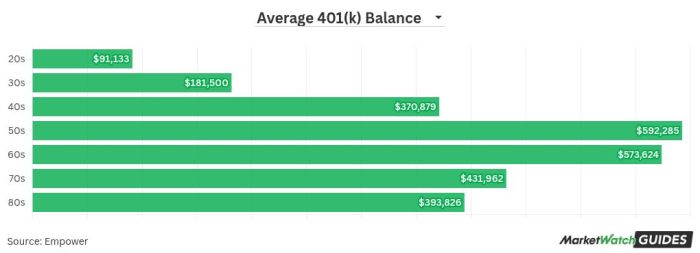
The concept of retirement savings has been a cornerstone of American financial planning for decades. For many individuals, 401(k) plans have become the primary vehicle for accumulating wealth during one’s working years, with the ultimate goal of securing a comfortable retirement. As the United States grapples with an aging population and shifting retirement landscapes, it’s essential to examine the current state of 401(k) balances among 60-year-olds.
Historical Context of 401k Balances, Average 401k for 60 year old
According to the Employee Benefit Research Institute (EBRI), the average 401(k) balance for a 60-year-old in the United States has been steadily increasing over the years. Let’s take a look at the historical data:
| Year | Average 401k Balance | Percentage Change |
|---|---|---|
| 2000 | $43,000 | |
| 2010 | $72,100 | 67.6% |
| 2020 | $111,100 | 54.2% |
As evident from the table, the average 401(k) balance for a 60-year-old has grown significantly since 2000. This increase can be attributed to changes in retirement savings policies, such as the rise of automatic enrollment and the introduction of catch-up contributions.
Changes in Retirement Savings Policies
The EBRI data highlights the importance of policy changes in driving the growth of 401(k) balances. Automatic enrollment, which became more prevalent in the mid-2000s, has been particularly influential. By default enrolling employees into 401(k) plans, organizations have seen higher participation rates and increased savings.
According to the EBRI, automatic enrollment has led to a 2-3 percentage point increase in 401(k) participation rates.
In addition to automatic enrollment, the introduction of catch-up contributions has also played a significant role in boosting 401(k) balances. Catch-up contributions allow workers 50 and older to contribute an additional amount to their 401(k) accounts, on top of the standard contribution limits.
- Automatic enrollment has led to higher participation rates and increased savings among 401(k) plan participants.
- Catch-up contributions have allowed workers 50 and older to supplement their retirement savings, leading to higher 401(k) balances.
- The growing trend of robo-advisors and online investment platforms has made it easier for individuals to manage their 401(k) accounts and make informed investment decisions.
Future Outlook
As the United States continues to grapple with an aging population, the importance of retirement savings will only continue to grow. With the average 401(k) balance for a 60-year-old expected to continue increasing, it’s essential for policymakers and financial planners to prioritize education and outreach efforts to ensure that workers are taking full advantage of available retirement savings options.
Retirement Income Sources Beyond 401k for a 60-year-old: Average 401k For 60 Year Old

For a 60-year-old, retirement often marks a significant shift in life, where financial planning and diversification become crucial for a sustainable and enjoyable post-work life. While a 401k balance is a vital component, it’s essential to explore other income sources to ensure a secure and fulfilling retirement. Having a diversified income stream is paramount in retirement, as it significantly reduces the risk of outliving one’s savings.
A well-rounded income plan can include Social Security benefits, pensions, annuities, and even part-time work or freelancing. This multi-stream approach not only guarantees income stability but also the flexibility to pursue long-held passions and hobbies.
Key Income Sources
| Income Source | Average Income Amount (in USD) |
|---|---|
| Social Security Benefits | $2,450 (average monthly benefit as of 2023) |
| Pensions | $1,700 (average monthly pension payment as of 2023) |
| Annuities | $1,000 (median annual annuity payment as of 2023) |
| Part-time Work or Freelancing | Variable, but estimated average annual income: $15,000 – $30,000 |
Real-Life Examples
Mary, a 62-year-old former teacher, relies on her pension and Social Security benefits for about 70% of her income. She supplements her income with part-time tutoring and online courses, allowing her to maintain an active lifestyle and explore her passion for art. Meanwhile, John, a 65-year-old retired accountant, earns about 40% of his total income from a small business he started in retirement, leveraging his expertise to create a sustainable and fulfilling income stream.
By diversifying their income sources, both Mary and John have achieved a comfortable retirement, with the freedom to pursue their interests without financial constraints. This multi-faceted approach not only mitigates the risks associated with a single income source but also provides a sense of security and financial peace of mind. A well-structured income plan can greatly benefit a 60-year-old in retirement, providing the flexibility to navigate life’s challenges and pursue new opportunities.
By understanding the importance of multiple income streams and exploring available options, individuals can create a stable and fulfilling financial foundation for their post-work years.
Popular Questions
What is the average 401k balance for a 60-year-old in the United States today?
According to the Employee Benefit Research Institute, the average 401k balance for a 60-year-old in the United States is approximately $120,000 in 2022.
How has the average 401k balance changed over time?
The average 401k balance for a 60-year-old has experienced a significant increase over the past few decades, with a median balance of $120,000 in 2022, compared to $70,000 in 2000.
What are the primary factors contributing to variations in the average 401k balance among 60-year-olds?
The primary factors influencing the average 401k balance among 60-year-olds include employer matching contributions, employee saving rates, investment choices, and individual financial behavior.
