How rich is the 1 percent net worth is a question that sparks debate and curiosity worldwide, as the concentration of wealth among the elite continues to shape global economies and societies. With an estimated 87% of global wealth controlled by just 1% of the population, this phenomenon has far-reaching implications on access to education, healthcare, and economic opportunities.
The concept of the 1 percent has become synonymous with wealth and power, with a net worth threshold that varies across countries and historical periods. From the lavish lifestyles of the rich and famous to the quiet accumulations of wealth through inheritance and entrepreneurship, the 1 percent has become a focal point for discussions on income inequality, economic mobility, and social justice.
Global Wealth Concentration

The wealth of the top 1 percent has always been a topic of interest, with its concentration varying across different regions of the world. According to a report by Oxfam, the world’s richest 1 percent now hold twice as much wealth as the rest of the global population combined, with the global wealth gap continually widening.
The Top 5 Countries with the Most Concentrated Wealth among the 1 Percent
The global wealth concentration varies across different countries, with some regions experiencing faster growth in wealth disparity than others. Let’s take a look at the top 5 countries with the most concentrated wealth among the 1 percent.
“The concentration of wealth among the 1 percent is a phenomenon not exclusive to one geographical region.”
Global Wealth Report 2022.
| Rank | Country | Wealth Concentration among the 1 Percent |
|---|---|---|
| 1 | Switzerland | 73.8% |
| 2 | United States | 63.2% |
| 3 | Singapore | 62.3% |
| 4 | Japan | 59.4% |
| 5 | Hong Kong | 58.3% |
Comparing the 1 Percent Wealth Share Across Regions, How rich is the 1 percent net worth
When comparing the 1 percent wealth share across various regions, we notice distinct patterns. According to the Global Wealth Databook 2022, North America has the highest wealth concentration, with 64.4 percent of its wealth held by the 1 percent.
Regional Variations
The reasons behind regional variations in wealth concentration are complex and multi-faceted. Several factors contribute to the widening of the wealth gap, including:
- Lack of social mobility
- Weakened social safety nets
- Rise of income inequality
- Increased concentration of wealth among the 1 percent
- Globalization and automation of the labor market
These factors are interconnected and often exacerbate each other, resulting in a vicious cycle of wealth concentration and inequality. Understanding the driving forces behind these regional variations can help policymakers and social leaders develop targeted interventions to address the growing wealth disparities.
Factors Driving Regional Variations
The wealth concentration among the 1 percent is influenced by various factors, including economic policies, societal values, and demographic trends. Let’s explore some of these factors in greater detail.
Wealth Concentration and Taxation
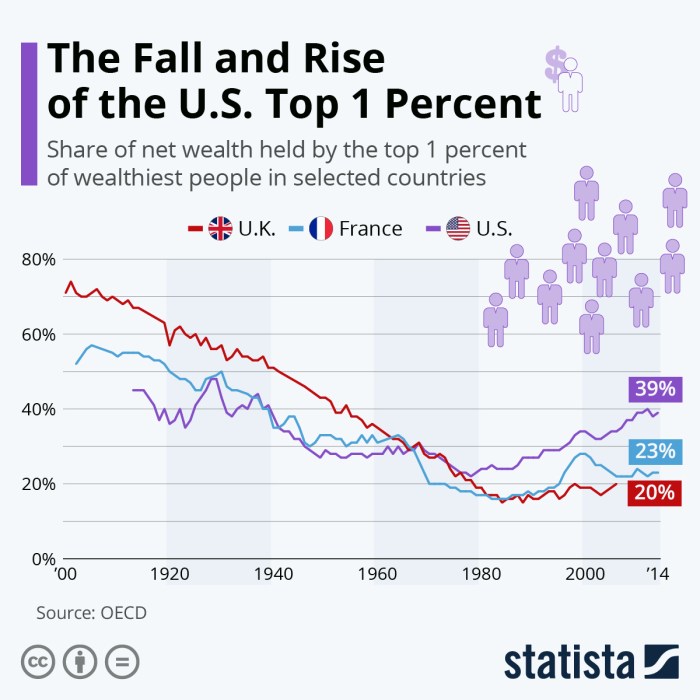
In the United States, the wealthiest 1 percent hold a staggering 38.6 percent of the country’s wealth, leaving a significant wealth gap between the rich and the poor. This concentration of wealth has severe effects on the economy, limiting social mobility and perpetuating inequality.
Redistributive Policies through Progressive Taxation
A progressive tax system, where the wealthy are taxed at a higher rate, can be an effective strategy to reduce wealth concentration. In a progressive tax system, the tax rate increases as the taxpayer’s income increases. By implementing a more progressive tax system, we can increase tax revenue from the wealthy, allowing for a more even distribution of resources.A hypothetical example of a progressive tax system could be implemented as follows:
- 10% tax rate on the first $10,000 of taxable income
- 20% tax rate on taxable income between $10,001 and $50,000
- 30% tax rate on taxable income between $50,001 and $100,000
- 40% tax rate on taxable income between $100,001 and $200,000
- 45% tax rate on taxable income above $200,000
In this example, individuals with higher incomes would pay a higher tax rate, increasing tax revenue and reducing wealth concentration.
The Role of Tax Havens and Loopholes
Tax havens and loopholes exacerbate wealth concentration by allowing the wealthy to avoid paying taxes on their income. These tax havens, often located in countries with lenient tax laws, provide a means for individuals and corporations to hide their income and avoid paying their fair share of taxes. The use of tax loopholes and havens can lead to a loss of tax revenue for governments and perpetuate wealth concentration.A study by the Organization for Economic Cooperation and Development (OECD) found that multinational corporations avoided paying $444 billion in taxes between 2012 and 2015 by using tax avoidance strategies, including setting up subsidiaries in tax havens and taking advantage of tax loopholes.
Successful Tax Reforms
Successful tax reforms have reduced wealth inequality and increased tax revenue in countries around the world. For example:
- In Sweden, a progressive tax system, coupled with a universal child benefit, has contributed to reduced income inequality and increased social mobility.
- In Denmark, a tax reform in 2010 implemented a more progressive tax system and increased tax revenue, allowing for significant investments in social welfare programs.
- In Iceland, a tax reform in 2015 introduced a more progressive tax system and reduced wealth inequality, allowing for significant investments in education and healthcare.
These examples demonstrate the effectiveness of progressive taxation and tax reforms in reducing wealth concentration and promoting social equality.
Essential Questionnaire: How Rich Is The 1 Percent Net Worth
What is the estimated number of people worldwide who meet the 1 percent wealth threshold?
According to a 2020 report by Credit Suisse, approximately 46 million adults worldwide possess wealth exceeding $1.1 million, representing about 1% of the global adult population.
How does wealth concentration among the 1 percent impact access to education and economic opportunities?
Studies have shown that individuals from wealthier backgrounds have greater access to quality education, networking opportunities, and resources necessary to launch successful careers, thereby perpetuating intergenerational wealth disparities.
What are some effective strategies for redistributive policies to address wealth concentration?
Implementing progressive taxation, closing tax loopholes, and promoting inheritance taxes are some examples of policies that can help reduce wealth concentration and promote economic mobility.
How does regional variation in wealth concentration impact global economic indicators like GDP growth and inflation?
Country-specific wealth concentration rates have been linked to variations in GDP growth, inflation, and other macroeconomic indicators, underscoring the need for tailored policy responses to address regional disparities.
