Bay area median net worth 2025 – As the Bay Area’s median net worth 2025 takes center stage, it becomes increasingly apparent that the region’s high-tech economy has created both unprecedented wealth and deepening income inequality. The area’s ever-changing landscape is influenced by economic shifts and demographic changes, gentrification, and the displacement of long-time residents. This phenomenon is impacting families’ ability to accumulate wealth, with some benefiting from increased earning potential and savings, while others struggle to make ends meet.
The impact of gentrification and displacement on the Bay Area’s median net worth is a pressing concern. As long-time residents are priced out of their neighborhoods, the region’s economic landscape undergoes a significant transformation. The cost of living continues to skyrocket, leaving low- and middle-income families vulnerable to eviction and financial instability. Meanwhile, the tech industry’s rapid growth drives up housing costs, reducing the availability of affordable housing options for residents of all income levels.
Education and Income in the Bay Area’s Median Net Worth: A Crucial Relationship
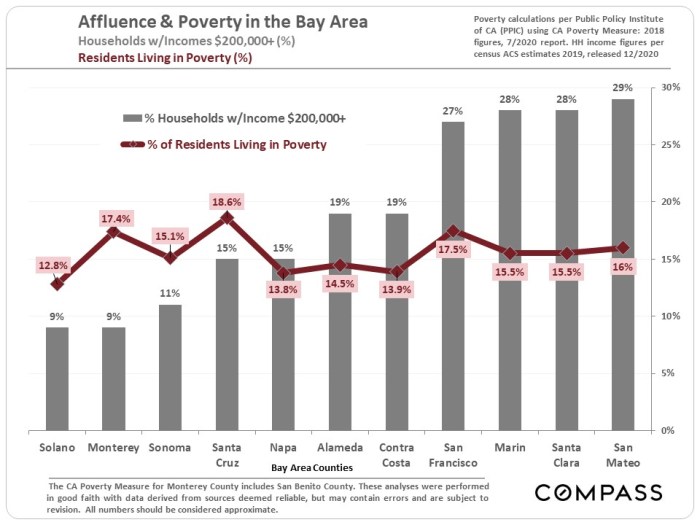
The Bay Area, a hub of innovation and technological advancement, boasts a median net worth that is significantly influenced by the intersection of education and income. In this discussion, we will delve into the correlation between the two and explore how access to higher education and vocational training programs can impact an individual’s earning potential and savings. Furthermore, we will examine the effects of student loan debt on Bay Area residents’ ability to build wealth.A higher education can significantly boost an individual’s earning potential.
Research has shown that workers with a bachelor’s degree or higher have median weekly earnings that are approximately $1,420 higher than those with only a high school diploma. In the Bay Area, this translates to a substantial increase in net worth. According to data from the United States Census Bureau, among Bay Area residents aged 25 to 64, those with a bachelor’s degree or higher had a median net worth of $343,000, compared to $64,000 for those with only a high school diploma.
The Impact of Higher Education on Earning Potential
- The median weekly earnings for workers with a bachelor’s degree or higher in the Bay Area were approximately $1,420 higher than those with only a high school diploma.
- A study by the Center for Economic Development found that for every dollar earned, a high school dropout would have required about 3.6 years of employment to earn the same amount as a college-educated worker.
- A person with a college degree can expect to earn about 50% more than someone with only a high school diploma throughout their lifetime.
Access to Higher Education and Vocational Training Programs
The Role of Student Loan Debt in Building Wealth
- The total student loan debt in the United States has surpassed $1.7 trillion, with the average debt per student exceeding $31,300.
- A study by the Federal Reserve estimated that for every dollar of student loan debt, a borrower’s credit score drops by 15 to 20 points.
- A survey by the National Foundation for Credit Counseling found that nearly 40% of student loan borrowers reported struggling to make their payments.
Breaking Down the Barriers to Higher Education and Wealth Creation
A Comparison of the Bay Area’s Median Net Worth with Other High-Tech Hubs
As the tech industry continues to boom, cities like Seattle, San Diego, and the Bay Area find themselves at the forefront of innovative economic growth. Median net worth is a critical indicator of a city’s economic health, reflecting the collective wealth of its residents. In this comparison, we’ll delve into the numbers, exploring how these high-tech hubs differ in their impact on residents’ wealth.The Bay Area, known for its thriving Silicon Valley, boasts a median net worth of $650,000 per household.
This figure is significantly higher than other high-tech hubs, such as Seattle ($410,000) and San Diego ($340,000). But why the disparity?
Job Market Dynamics: A Key Driver of Median Net Worth
Job market dynamics play a crucial role in shaping a city’s median net worth. Cities with high demand for skilled workers, such as software engineers and data analysts, tend to have higher median net worth. The Bay Area’s strong presence of tech giants like Google, Facebook, and Apple drives up demand for these professionals, leading to higher salaries and increased wealth creation.In Seattle, the tech industry’s growth has been fueled by the success of companies like Amazon and Microsoft.
While the job market is strong, the cost of living in Seattle is relatively high, which may impact the median net worth of residents. San Diego, on the other hand, has a more diversified economy, with a strong presence of biotech and telecommunications companies. This diversity helps to drive economic growth, but may not have the same impact on median net worth as the tech-driven economies of the Bay Area and Seattle.
Housing Costs: A Major Obstacle to Wealth Creation
Housing costs are a significant factor in determining median net worth. Cities with high housing prices, such as the Bay Area and Seattle, tend to have lower median net worth. This is because a larger portion of residents’ income is dedicated to housing expenses, leaving less room for savings and investment.In the Bay Area, the median home price exceeds $1 million, with many residents opting for high-rise apartments or sharing living spaces.
This has led to a shortage of affordable housing options, further exacerbating the wealth gap. In Seattle, the median home price is around $820,000, with a similar shortage of affordable housing options. San Diego’s median home price is relatively lower, around $640,000, but the city still faces challenges in providing affordable housing options.
A Comparison of Median Net Worth: A Bar Graph
The following bar graph illustrates the median net worth in each city, highlighting the differences and trends:| City | Median Net Worth || — | — || Bay Area | $650,000 || Seattle | $410,000 || San Diego | $340,000 |This graph reveals that the Bay Area has the highest median net worth, followed by Seattle and then San Diego.
The disparity in median net worth reflects the unique economic dynamics of each city, driven by job market demand, housing costs, and economic diversity.In conclusion, a comparison of the Bay Area’s median net worth with other high-tech hubs reveals the complexities of economic growth and wealth creation. While the Bay Area boasts the highest median net worth, its residents face challenges related to housing costs and affordability.
By understanding the factors driving these differences, we can better navigate the opportunities and challenges presented by the tech industry.
Strategies for Increasing Access to Affordable Housing and Building Wealth in the Bay Area

As the cost of living in the Bay Area continues to escalate, finding affordable housing has become an impossible dream for many residents. However, innovative solutions and government initiatives are emerging to address this pressing issue. Local organizations and government agencies are working together to create pathways to affordable housing, and we’ll examine some of the most promising strategies.In recent years, the Bay Area’s median net worth has become a topic of intense discussion.
One of the most significant factors affecting this statistic is the affordability of housing. As housing prices continue to rise, many residents are priced out of the market, leaving them with limited options for building wealth. To address this issue, local governments and organizations are implementing policies and programs aimed at increasing access to affordable housing.
Policy Changes: Rent Control and Inclusionary Zoning
Rent control and inclusionary zoning are two policy changes that have been implemented in the Bay Area to address the housing affordability crisis. Rent control limits the amount by which landlords can raise rents, ensuring that tenants are not priced out of their homes. Inclusionary zoning, on the other hand, requires developers to set aside a certain percentage of units in new construction projects for low-income residents.The impact of these policies on the Bay Area’s affordable housing landscape has been significant.
Rent control has helped to stabilize rent prices, and inclusionary zoning has increased the availability of affordable housing units. However, these policies have also been the subject of controversy, with some landlords and developers arguing that they stifle the development of new housing projects.
Shared Ownership: A New Path to Affordable Housing
Shared ownership programs are another innovative solution to the housing affordability crisis. These programs allow multiple individuals or families to purchase a home together, with each owner holding a share of the property. This approach can make homeownership more affordable, as the cost of the home is spread across multiple owners.Shared ownership programs are often used to create community land trusts, which are non-profit organizations that hold land in trust for the benefit of the community.
Community land trusts have been successful in preserving affordable housing and promoting community development.
Community Land Trusts: A Model for Affordable Housing
Community land trusts (CLTs) are non-profit organizations that hold land in trust for the benefit of the community. CLTs have been successful in preserving affordable housing and promoting community development. They work by acquiring land and leasing it to homeowners or renters at below-market rates.CLTs offer several benefits, including:
- Preservation of affordable housing: CLTs help to preserve existing affordable housing by acquiring and leasing it to low-income residents.
- Community development: CLTs often work with community members to develop and implement plans for community development, such as parks, community centers, and other public amenities.
- Increased affordability: CLTs offer below-market rates for housing, making it more affordable for low-income residents.
- Community control: CLTs are controlled by community members, giving them a voice in decisions about community development.
These benefits make community land trusts an attractive solution for addressing the housing affordability crisis in the Bay Area.
Pathways to Affordable Housing in the Bay Area, Bay area median net worth 2025
There are several pathways to affordable housing in the Bay Area.
-
Shared ownership: This involves multiple individuals or families purchasing a home together.
-
Rent control and inclusionary zoning: These policies limit the amount by which landlords can raise rents and require developers to set aside affordable housing units.
-
Community land trusts: These non-profit organizations hold land in trust for the benefit of the community and offer below-market rates for housing.
-
Homebuyer assistance programs: These programs offer financial assistance to low-income homebuyers, such as down payment assistance and closing cost assistance.
-
Housing vouchers: These programs provide rental assistance to low-income residents, helping them afford housing in the private market.
Each of these pathways offers a unique solution to the housing affordability crisis in the Bay Area.
Bay Area Median Net Worth and Its Relationship to Local Business Ownership

As the Bay Area continues to grow in economic stature, one key factor driving this growth is the relationship between local business ownership and median net worth. A closer examination of successful entrepreneurs who have built thriving businesses in the Bay Area reveals the profound impact of entrepreneurship on personal wealth. However, challenges persist for minority-owned businesses in accessing capital and scaling their operations in this competitive market.
Entrepreneurial Success Stories
Consider the case of Asha Bandele, a social entrepreneur who founded the organization Sistersong Women of Color Reproductive Justice Collective. Through her organization, Bandele has been able to create economic opportunities for women of color, empowering them to take control of their reproductive health and well-being. As a result of her work, Bandele’s net worth has significantly increased, reflecting the financial gains of her entrepreneurial endeavors.Similarly, Leila Janah’s organization, Samasource, has enabled marginalized communities to access economic resources and opportunities.
Janah’s success has been recognized through numerous accolades, including the Forbes 30 Under 30 list. These stories not only demonstrate the financial potential of local business ownership but also highlight the positive social impact that such ventures can have on the community.
Challenges Faced by Minority-Owned Businesses
Despite the success stories of entrepreneurs like Asha Bandele and Leila Janah, minority-owned businesses in the Bay Area continue to face significant challenges in accessing capital and scaling their operations. Black-owned businesses, in particular, have historically struggled to secure loans and investments, with many citing lack of access to networking opportunities, mentorship, and capital as major barriers to growth.In fact, a study by the Federal Reserve found that in 2019, only 2% of small business loans were issued to Black-owned businesses, despite making up 13% of all small businesses.
This disparities in access to capital not only hinder the economic growth of minority-owned businesses but also limit the potential for increased personal wealth and improved economic mobility within these communities.
Comparative Analysis of Net Worth in High-Tech Hubs
To understand the broader implications of local business ownership on median net worth, it is essential to examine the net worth of small business owners in the Bay Area compared to those in other high-tech hubs. According to a study by the Economic Innovation Group, the median net worth of small business owners in the Bay Area was $245,000 in 2020, significantly higher than the national average of $145,000.In contrast, small business owners in cities like Austin, Texas, and Nashville, Tennessee, reported median net worth of $120,000 and $90,000, respectively.
These disparities reflect the unique dynamics of the Bay Area economy and the opportunities and challenges that exist for local business owners.
- A critical factor contributing to the high median net worth of Bay Area business owners is the presence of large corporations and venture capital firms, providing access to capital and resources for growth.
- The region’s highly skilled workforce and high demand for goods and services also create a fertile ground for small businesses to thrive and generate wealth.
- However, the high cost of living and doing business in the Bay Area is a significant challenge, making it difficult for smaller companies to access and compete for resources.
The disparity in median net worth between the Bay Area and other high-tech hubs serves as a reminder of the complexities involved in promoting economic mobility and wealth creation among marginalized communities. By examining the stories of successful entrepreneurs, challenges faced by minority-owned businesses, and comparative analysis of net worth, we can gain a deeper understanding of the relationship between local business ownership and median net worth in the Bay Area.
“Entrepreneurship is not just a means to personal wealth but also an opportunity to create economic empowerment and opportunities for marginalized communities.”
The Bay Area’s unique economic landscape and the challenges faced by minority-owned businesses underscore the importance of creating inclusive policies and programs that promote economic mobility and wealth creation. By exploring these issues, we can work towards creating a more equitable and prosperous future for all entrepreneurs, regardless of their background or identity.
Key Questions Answered: Bay Area Median Net Worth 2025
What is the primary driver of the Bay Area’s rising income inequality?
Gentrification and the displacement of long-time residents, driven by the region’s booming high-tech economy, are the primary drivers of the Bay Area’s rising income inequality.
How does gentrification impact low- and middle-income families?
Gentrification forces low- and middle-income families to choose between relocating to more affordable areas or facing financial instability, as rising housing costs make it increasingly difficult to maintain a stable income.
What role does education play in shaping the Bay Area’s median net worth?
Education plays a vital role in shaping the Bay Area’s median net worth, as access to higher education and vocational training programs can significantly increase one’s earning potential and contribute to savings.
How do systemic barriers to wealth accumulation impact communities of color in the Bay Area?
Communities of color in the Bay Area face systemic barriers to wealth accumulation, including housing segregation, biased lending practices, and limited access to resources and opportunities.
