401k target by age –
As the clock ticks away, it’s never too early to start planning for your golden years, but the earlier you begin, the more substantial your retirement savings will be. With 401(k) plans, compound interest can work in your favor, growing your savings exponentially over time. Consider the success stories of individuals and businesses that have implemented retirement savings plans early on, reaping the benefits of steady growth and maximizing their returns.
But what’s the ideal contribution ratio, and how can you achieve financial stability amidst an array of investment options?
Understanding the importance of starting 401(k) savings early in life is crucial. It’s a long-term game, and the impact of delayed savings can be significant. Successful individuals and businesses have demonstrated the benefits of consistent retirement savings, and the role of compound interest in growing 401(k) savings over time is a crucial element to consider.
By contributing to a 401(k) plan consistently, you can achieve maximum savings and ensure a secure financial future.
Understanding the Importance of 401(k) Saving for Different Age Groups

Retirement savings through 401(k) plans have become a crucial aspect of financial planning, allowing individuals to secure a stable financial future. The concept of compound interest has long been a topic of discussion in the world of finance, and its significance in growing 401(k) savings cannot be overstated. In this section, we’ll delve into the importance of starting 401(k) savings early in life, explore the impact of delayed savings on long-term growth, and discuss the role of compound interest in achieving maximum savings.
The Power of Early Start
Research has consistently shown that individuals who start saving early in their careers tend to accumulate significantly more wealth than those who delay their savings. This is due in large part to the power of compound interest, which can turn small, consistent contributions into substantial sums over time. According to a study by Fidelity Investments, employees who start saving in their 20s can accumulate up to 3x more than those who start saving in their 30s, assuming a 5% annual return.
In the context of retirement savings, this can translate to a significant difference in the quality of life during one’s golden years.
Compound Interest: The Force Behind 401(k) Growth
Compound interest is the eighth wonder of the world. He who understands it, earns it; he who doesn’t, pays it.
These words of wisdom from Albert Einstein highlight the importance of understanding compound interest in the context of 401(k) savings. In essence, compound interest is the interest earned on both the principal amount and any accrued interest over time. This leads to an exponential growth in savings, making it a crucial component of any retirement strategy.As an example, let’s consider an individual who contributes $10,000 to their 401(k) plan at the age of 25, with an annual return of 5%.
Assuming the individual contributes $500 per month for 10 years, the total contribution would be $60,000. With an average annual return of 5%, the total balance after 10 years would be approximately $123,419. However, if the individual were to delay their savings by 5 years, starting at 30, the total balance after 15 years would be approximately $83,419. This highlights the significance of starting 401(k) savings early, as even a small difference in the starting age can result in a substantial impact on long-term growth.
The Importance of Consistency
Consistency is key when it comes to achieving maximum 401(k) savings. By contributing regularly and consistently, individuals can take advantage of compound interest and increase their chances of reaching their retirement goals. According to a study by the Pew Charitable Trusts, individuals who contribute 10% or more of their income to their 401(k) plan are more likely to retire with a stable financial future.
In contrast, those who contribute less than 10% may struggle to meet their retirement expenses.
Real-Life Examples
Successful individuals and businesses have long recognized the importance of 401(k) savings in securing a stable financial future. For instance, Warren Buffett, one of the most successful investors in history, has emphasized the importance of saving early and consistently. In fact, Buffett has said that he starts his investment decisions with a spreadsheet that begins with a 30-year investment time horizon.
Other notable examples include companies such as Google and Facebook, which offer generous 401(k) matching programs to encourage employees to save for retirement.
Determining Optimal 401(k) Contribution Levels Based on Age

As we navigate the complexities of retirement planning, one crucial aspect stands out: determining the ideal 401(k) contribution levels based on age. It’s not just about saving for the future; it’s about achieving financial stability and ensuring a comfortable retirement. By adjusting our contribution levels according to age, we can maximize our returns, minimize tax liabilities, and secure a solid financial foundation for the golden years.In the realm of retirement planning, age plays a significant role in determining optimal 401(k) contribution levels.
It’s essential to strike a balance between building wealth and maintaining liquidity, as contributions can impact one’s daily life and long-term financial security. Let’s dive into the nuances of contribution levels and explore the most suitable strategies for various age groups.
Ideal Contribution Ratio between 401(k) and Other Investment Vehicles
The ideal contribution ratio between 401(k) and other investment vehicles varies significantly across different age groups. A study by the Employee Benefit Research Institute (EBRI) suggests that a 60/40 allocation between 401(k) and other investment vehicles is a good starting point for early career professionals (20-30 years old). As we age, the ratio may shift towards more conservative investments. For instance, individuals close to retirement (60-65 years old) may consider a 30/70 allocation to ensure a steady income stream during their golden years.| Age Group | Ideal Contribution Ratio (401(k)) | Other Investment Vehicles || — | — | — || 20-30 years old | 60% | 40% || 30-40 years old | 55% | 45% || 40-50 years old | 50% | 50% || 50-60 years old | 45% | 55% || 60-65 years old | 30% | 70% |
Automatic Payroll Deductions versus Lump Sum Contributions
When it comes to contributing to 401(k), two approaches dominate the scene: automatic payroll deductions and lump sum contributions. Both methods have their merits, and the most suitable approach depends on individual circumstances.Automatic payroll deductions offer several benefits:* Convenience: Contributions are deducted automatically from your paycheck, making it easy to save consistently.
Discipline
Regular deductions promote a disciplined approach to saving, helping you stay on track with your retirement goals.
Time-averaging
Contributions are invested over time, allowing you to ride the waves of market fluctuations.On the other hand, lump sum contributions may provide:* Tax benefits: You can claim a deduction for the full amount in the year you contribute, potentially reducing your tax liability.
Flexibility
You can contribute larger sums at one time, rather than spreading them out throughout the year.However, lump sum contributions can also lead to reduced contributions over time, as the initial lump sum may take time to recover.
Calculating the Impact of Varying 401(k) Contribution Rates, 401k target by age
Let’s consider a hypothetical example to illustrate the impact of varying 401(k) contribution rates on an individual’s retirement fund.Assuming a 10% annual return on investment, a $100,000 401(k) balance at 25 years old can grow to approximately $1.5 million by age 65, based on a fixed 20% annual contribution rate. However, if the contribution rate increases by 10% each year, the final balance can swell to $3.5 million, showcasing the power of compounded returns and consistent contributions.| Age | 401(k) Balance | Contribution Rate | Final Balance || — | — | — | — || 25 | $100,000 | 20% | $1,500,000 || 25 | $100,000 | 30% | $3,500,000 |
Case Studies: Successes and Lessons Learns
Several case studies demonstrate the benefits of increasing 401(k) contributions over time. For instance, Sarah, a 30-year-old software engineer, began contributing 10% of her salary to her 401(k) in 2015. Over the next 10 years, she consistently increased her contribution rate by 10% each year, reaching a final contribution rate of 40%. As a result, her 401(k) balance grew from $30,000 to $200,000, providing a comfortable foundation for her retirement.Similarly, John, a 45-year-old entrepreneur, started contributing 20% of his income to his 401(k) in 2010.
By the end of 2020, he had increased his contribution rate to 30%, resulting in a 401(k) balance of $500,000. These stories highlight the importance of consistent contributions and strategic investment decisions in achieving financial stability during retirement.By understanding the ideal contribution ratio between 401(k) and other investment vehicles, embracing automatic payroll deductions or lump sum contributions, and calculating the impact of varying 401(k) contribution rates, individuals can create a robust retirement plan tailored to their unique needs and goals.
So, take the first step towards securing your financial future – start planning and saving today!
Balancing 401(k) Savings with Other Financial Priorities: 401k Target By Age
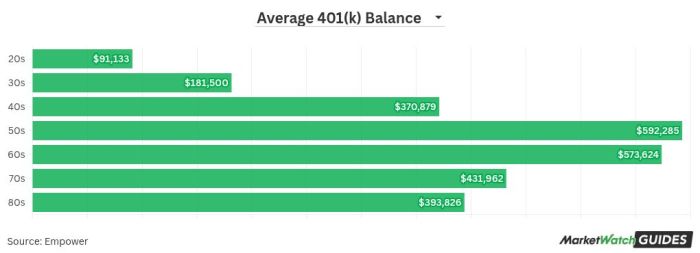
When it comes to 401(k) savings, many Americans focus solely on growing their retirement nest egg, without considering the broader financial landscape. However, neglecting other financial priorities can have serious consequences, such as accumulating high-interest debt and inadequate emergency funds. A balanced approach to financial planning is essential to ensure long-term financial stability and security.Balancing 401(k) savings with other financial priorities requires a comprehensive strategy that takes into account various financial goals, risk tolerance, and time horizons.
One effective approach is implementing a ‘payoff-your-debt-fast’ plan, which involves directing extra money towards high-interest debt repayment.
The Payoff-Your-Debt-Fast Plan
The payoff-your-debt-fast plan involves redirecting spare funds towards high-interest debt repayment, such as credit card balances or personal loans. By allocating a significant portion of disposable income towards debt repayment, individuals can eliminate high-interest debt quickly and avoid further financial damage. This strategy can have a significant impact on 401(k) savings growth, as reduced debt payments translate to increased room for retirement contributions.For instance, Sarah, a 35-year-old marketing specialist, had accumulated $10,000 in credit card debt with an average interest rate of 20%.
By implementing a payoff-your-debt-fast plan, Sarah redirected $1,000 per month from her 401(k) contributions towards debt repayment. Within 12 months, Sarah paid off her debt and redirected the $1,000 monthly allocation towards her 401(k), resulting in a 25% increase in her retirement savings.
Building an Emergency Fund
In addition to debt repayment, building an emergency fund is a critical component of a balanced financial plan. Unexpected expenses, such as car repairs or medical bills, can derail even the most well-intentioned savings plans. A cushion of readily accessible funds can help individuals navigate unexpected setbacks without compromising their long-term financial goals.Consider Emily, a 40-year-old freelancer who had saved six months’ worth of living expenses in an easily accessible savings account.
When Emily’s car broke down, she used her emergency fund to cover the repairs, instead of dipping into her 401(k) or taking on additional debt.
Consulting with a Financial Advisor
Developing a personalized financial plan that balances 401(k) savings with other financial priorities can be complex and time-consuming. Consulting with a financial advisor can provide valuable insights and expert guidance, helping individuals create a tailored strategy that addresses their unique financial needs and objectives.A financial advisor can assess an individual’s income, expenses, debt, and savings, then develop a comprehensive plan that allocates resources effectively across multiple financial goals.
By harnessing the expertise of a financial advisor, individuals can create a sustainable financial plan that balances 401(k) savings with other essential priorities, ensuring long-term financial stability and security.
Key Questions Answered
Can I withdraw my 401(k) funds at any time?
While you can withdraw your 401(k) funds before retirement, there may be penalties and taxes associated with early withdrawals. It’s essential to understand the rules governing 401(k) withdrawals and required minimum distributions (RMDs) to avoid any financial repercussions.
What’s the ideal 401(k) contribution ratio?
The ideal contribution ratio varies depending on age and financial goals. It’s recommended to contribute at least 10% to 15% of your income to a 401(k) plan, but the ideal ratio may be higher for some individuals, especially those with high disposable incomes.
Can I contribute to a 401(k) plan if I’m self-employed?
Yes, self-employed individuals can contribute to a 401(k) plan, but it’s essential to understand the rules and regulations governing self-employed retirement plans. You may be eligible to deduct your contributions from your taxable income and enjoy tax benefits.
How do I choose the right investment options for my 401(k) plan?
Choosing the right investment options for your 401(k) plan involves considering your risk tolerance, financial goals, and time horizon. It’s essential to diversify your portfolio across different asset classes, such as stocks, bonds, and real estate, to minimize risk and maximize returns.
