In a world where wealth and power are intricately linked, the net worth of the royalty family is a multifaceted entity that has evolved over centuries, influenced by a blend of tangible and intangible assets, strategic business ventures, and public funds. Like a rich tapestry, their net worth is woven from threads of inheritance, real estate, business partnerships, philanthropy, and cultural significance, each strand intricately intertwined with the others.
From feudal times to modern-day monarchies, royal families have adapted and transformed to maintain their wealth, navigating the complexities of social and economic changes while also influencing national economies and societal attitudes. This intricate dance between tradition and innovation has resulted in vast disparities in net worth, with some royal families leveraging their positions to amass immense fortunes, while others struggle to maintain relevance in a rapidly changing world.
Historical Developments in Royal Family Net Worth

The wealth of royal families has undergone significant transformations throughout history, closely tied to the shifts in global politics, economies, and social structures. From the feudal system to modern-day monarchies, their net worth has evolved in response to various events and developments.One of the earliest recorded instances of royal wealth dates back to medieval Europe, where monarchs amassed vast fortunes through land ownership, taxation, and trade.
The feudal system, with lords and vassals vying for power, created a complex web of obligations and entitlements that contributed to the concentration of wealth among royalty. However, this system also ensured that monarchs’ wealth was largely tied to their ability to govern and maintain control over their territories.As the centuries passed, significant events impacted the net worth of royal families.
The rise of centralized states, colonial empires, and global capitalism further transformed their fortunes. The industrial revolution, for instance, enabled monarchies to invest in emerging industries and capitalize on new economic opportunities. However, the accompanying social and economic changes also led to increased scrutiny of royal wealth and its relationship to the general population.
The Impact of Social and Economic Changes on Royal Family Wealth
The evolution of royal family wealth reflects the broader shifts in global society and economy. Changes in taxation, trade policies, and technological advancements have influenced their fortunes. Consider the following five key events that significantly impacted the net worth of royal families in the past century:
- World War I: This global conflict depleted monarchies’ resources, as many royal families were forced to bear significant war-related expenses. As a result, their net worth suffered a significant decline.
- The Great Depression: The economic downturn of the 1930s affected even the wealthiest of monarchies, as global trade and investment dwindled. Some royal families were forced to liquidate assets to maintain their households and cover expenses.
- The decolonization of Africa and Asia: As colonial empires dissolved, many monarchies lost control over vast territories and the associated wealth. The transition to independent nations led to the redistribution of wealth and power.
- The oil boom of the late 20th century: Monarchies in oil-rich countries experienced a sudden surge in wealth, as international demand for fossil fuels skyrocketed. This influx of revenue enabled them to invest in infrastructure, tourism, and other sectors.
- The global financial crisis of 2008: This economic downturn hit many monarchies hard, particularly those reliant on foreign investment and trade. Some royal families were forced to re-evaluate their financial strategies and diversify their assets.
Cultural Significance of Royalty Net Worth in Modern Society
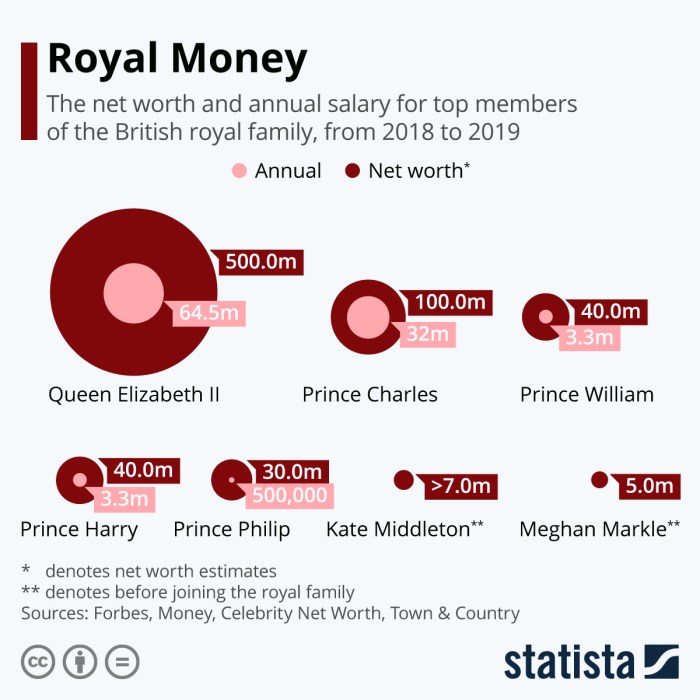
The cultural significance of royalty net worth in modern society is multifaceted and far-reaching. The public’s fascination with the wealth and possessions of royal families is a reflection of our inherent desire to understand and relate to those in positions of power. The media’s portrayal of royal family net worth, through headlines, articles, and documentaries, plays a significant role in shaping public perception and influencing societal attitudes.The media’s focus on royal family wealth can create a sense of glamour and luxury, often romanticizing the idea of living a life of opulence and privilege.
However, this portrayal can also perpetuate negative stereotypes and reinforce class divisions. Research has shown that media coverage of wealth and fame can lead to increased social comparison, decreased self-esteem, and a sense of disconnection among those who feel they cannot achieve a similar level of success.
Media Portrayals and Public Perception
The media’s depiction of royal family net worth can have a profound impact on public perception and societal attitudes. A 2020 study published in the Journal of Media Psychology found that exposure to media coverage of celebrity wealth was associated with increased materialism and decreased life satisfaction among young adults.Media outlets often focus on the most visible and extravagant aspects of royal family wealth, such as lavish homes, expensive jewelry, and exotic vacations.
This selective presentation can create a distorted view of what it means to be wealthy and successful, reinforcing the idea that wealth is solely about accumulating possessions and status symbols.
Royal Family Wealth and National Economies
The wealth of royal families can also have a significant impact on national economies. In the UK, for example, the British monarchy is estimated to be worth over £85 billion, with the Queen’s personal wealth estimated to be around £300-400 million. This wealth is largely based on investments, assets, and financial reserves accumulated over centuries.The royal family’s wealth plays a role in job creation and economic growth in several ways:* Tax revenue: The royal family’s assets and investments generate significant tax revenue for the British government, which contributes to the national economy.
Tourism and travel
The monarchy attracts millions of tourists each year, generating revenue for the UK economy through tourism and travel.
Charitable initiatives
The royal family’s philanthropic efforts, such as the Queen’s Charitable Trust and the Prince’s Trust, support various causes and organizations, contributing to social and economic development.
Charitable Initiatives and Philanthropy, Net worth of the royalty family
The royal family’s charitable initiatives and philanthropic efforts have a significant impact on society. The Queen’s Charitable Trust, for example, supports causes such as arts and culture, education, and healthcare. The Prince’s Trust, founded by Prince Charles, focuses on supporting young people in education, employment, and entrepreneurship.Some notable examples of royal family charitable initiatives and philanthropy include:
- The Queen’s Golden Jubilee celebrations in 2002 raised over £150 million for charity, supporting causes such as arts, culture, and education.
- The Duke and Duchess of Cambridge’s royal tour of Australia in 2014 raised over £50 million for charity, supporting causes such as mental health and conservation.
- The Prince’s Trust has supported over 825,000 young people in the UK since its inception, helping them to gain education, employment, and entrepreneurship skills.
Taxation and Wealth Transparency of Royal Families: Net Worth Of The Royalty Family

Taxation is a critical aspect of royal families’ lives, with many countries having specific laws and regulations governing their tax obligations. The complexity of royal tax laws can make it challenging to understand how much these families are paying in taxes. However, several royal families have made efforts to increase transparency and accountability in their financial dealings.The British royal family, for instance, is subject to various taxes, including income tax, capital gains tax, and value-added tax.
The Queen’s private estates are also subject to business rates and council tax. However, the monarch’s personal income is not subject to income tax, as it is considered to be part of their official duties. The Queen’s private wealth is estimated to be around $400 million, with much of it coming from inherited assets and investments.Some royal families have taken steps to increase transparency and accountability in their financial dealings.
The Saudi royal family, for example, has been criticized for its lack of transparency in financial matters. However, in recent years, the family has begun to take steps to increase transparency, including publishing its budget and financial reports online.Similarly, the Qatari royal family has also made efforts to increase transparency in its financial dealings. The family has established a number of institutions and boards to oversee its finances and ensure that they are being used responsibly.
Tax Laws Applicable to Royal Families
Tax laws applicable to royal families vary depending on the country and the specific royal family in question. In the United Kingdom, for example, the royal family is subject to the same tax laws as ordinary citizens, although there are some exceptions. The monarch’s personal income is not subject to income tax, and the Queen’s private estates are exempt from business rates and council tax.However, the royal family’s tax obligations are complex and can be difficult to understand.
The Queen’s private wealth is not subject to inheritance tax, as it passes to the monarch on her death. This means that the royal family’s wealth can be passed down through generations without being subject to significant taxes.
- Income Tax: The Queen’s private income is subject to income tax, although the monarch’s personal income is exempt.
- Capital Gains Tax: The royal family’s investments are subject to capital gains tax, although the family’s private wealth is exempt.
- Business Rates: The Queen’s private estates are exempt from business rates.
- Council Tax: The Queen’s private estates are exempt from council tax.
Measures Taken by Royal Families to Increase Transparency and Accountability
Several royal families have taken steps to increase transparency and accountability in their financial dealings. The British royal family, for example, has established a number of institutions and boards to oversee its finances and ensure that they are being used responsibly.The Saudi royal family has also made efforts to increase transparency in its financial dealings. The family has established a number of institutions and boards to oversee its finances and ensure that they are being used responsibly.Similarly, the Qatari royal family has also made efforts to increase transparency in its financial dealings.
The family has established a number of institutions and boards to oversee its finances and ensure that they are being used responsibly.
Examples of Royal Families that Have Made Efforts to Reduce Their Tax Burdens and Increase Public Engagement
Several royal families have made efforts to reduce their tax burdens and increase public engagement. The British royal family, for example, has established a number of institutions and boards to oversee its finances and ensure that they are being used responsibly.Similarly, the Qatari royal family has also made efforts to increase transparency in its financial dealings. The family has established a number of institutions and boards to oversee its finances and ensure that they are being used responsibly.The Saudi royal family has also made efforts to increase transparency in its financial dealings.
The family has established a number of institutions and boards to oversee its finances and ensure that they are being used responsibly.
Qatari Royal Family’s Efforts to Increase Transparency
The Qatari royal family has made significant efforts to increase transparency in its financial dealings. The family has established a number of institutions and boards to oversee its finances and ensure that they are being used responsibly.The Qatari royal family’s efforts to increase transparency include:
- Publishing its budget and financial reports online
- Establishing a number of institutions and boards to oversee its finances
- Introducing reforms to increase accountability and transparency
- Implementing measures to reduce corruption and mismanagement
The Qatari royal family’s efforts to increase transparency have been widely praised, and the family has been recognized as a leader in the region in terms of transparency and accountability.
Saudi Royal Family’s Efforts to Increase Transparency
The Saudi royal family has also made significant efforts to increase transparency in its financial dealings. The family has established a number of institutions and boards to oversee its finances and ensure that they are being used responsibly.The Saudi royal family’s efforts to increase transparency include:
- Publishing its budget and financial reports online
- Establishing a number of institutions and boards to oversee its finances
- Introducing reforms to increase accountability and transparency
- Implementing measures to reduce corruption and mismanagement
The Saudi royal family’s efforts to increase transparency have been widely praised, and the family has been recognized as a leader in the region in terms of transparency and accountability.
Transparency and accountability are essential for good governance and financial management.
The royal family’s tax obligations and efforts to increase transparency and accountability are complex and multifaceted. However, by understanding these issues and the efforts being made to address them, we can gain a better understanding of the royal family’s role in society and the steps being taken to ensure that their finances are being used responsibly.
Modern Trends and Future Directions in Royal Family Wealth

As the world becomes increasingly digitalized, royal families are adapting to the changing landscape by leveraging technology to manage and grow their wealth. Digitalization has brought about unprecedented opportunities for royal families to diversify their investments, streamline their operations, and enhance their philanthropic efforts. This shift towards digitalization is a natural progression, given the accelerated pace of technological advancements in recent years.
The Rise of Royal Family Entrepreneurship
Royal families have traditionally been associated with luxury brands and ventures. However, in recent years, there has been a growing trend of royal family entrepreneurship, where members of the royal family are actively involved in starting and running their own businesses. This shift is driven by the desire to diversify revenue streams, create jobs, and promote innovation. For instance, the Prince of Wales has invested in several eco-friendly ventures, including a sustainable fashion brand and a company specializing in renewable energy.Some notable examples of royal family entrepreneurship include:
- The Danish Crown Prince Couple’s investment in the eco-friendly furniture brand, Økohå. The brand focuses on sustainable design and environmentally friendly production methods.
- The Norwegian Royal Family’s support for the innovative start-up, Smartify, which aims to make art and culture more accessible to the general public.
- The British Royal Family’s investment in the luxury fashion brand, Reiss. The brand has become a staple in British fashion, with a strong online presence and a focus on quality and sustainability.
- The Spanish Royal Family’s ownership of the luxury hotel chain, Hotel Ritz. The chain has undergone significant renovations and is now a leader in the hospitality industry.
- The Swedish Royal Family’s investment in the innovative tech company, Spotify. The company has disrupted the music streaming industry and has become a household name.
Emerging Trends in Royal Family Philanthropy and Social Responsibility
Royal families have always played a significant role in philanthropy and social responsibility. However, there are several emerging trends in this area that are worth noting:
- Focus on Mental Health: Many royal families are now prioritizing mental health initiatives, such as the British Royal Family’s support for the charity, Mind, which focuses on mental health awareness and support.
- Sustainability and Climate Change: Royal families are becoming increasingly aware of the importance of sustainability and reducing their carbon footprint. The Norwegian Royal Family has taken the lead in this area, investing in renewable energy projects and promoting eco-friendly practices.
- Digital Philanthropy: With the rise of digitalization, royal families are leveraging technology to amplify their philanthropic efforts. The Danish Crown Prince Couple has launched a mobile app that allows users to donate to various charities and causes.
- Community Development: Royal families are shifting their focus towards community development initiatives, such as educational programs, community centers, and job training programs. The Spanish Royal Family has launched several initiatives aimed at promoting education and economic development in disadvantaged communities.
- Disaster Relief and Humanitarian Efforts: Royal families are playing a crucial role in disaster relief and humanitarian efforts. The British Royal Family has provided significant support to various disaster relief efforts around the world, including the recent COVID-19 pandemic.
The Future of Royal Family Wealth
As the world continues to change at an unprecedented pace, royal families will need to adapt and evolve to remain relevant and effective. The future of royal family wealth is likely to involve more digitalization, entrepreneurship, and philanthropy. With the rise of social media, royal families will need to be more transparent and authentic in their efforts to connect with their audiences.
They will also need to prioritize sustainability and social responsibility, as these issues become increasingly important to their constituents. By embracing these trends and priorities, royal families can ensure their continued relevance and effectiveness in the years to come.
Question & Answer Hub
Q: How do royal families typically accumulate wealth?
A: Royal families often accumulate wealth through a combination of inheritance, business ventures, real estate investments, and public funds, which can include grants, donations, and other forms of financial support.
Q: Are royal families subject to the same tax laws as ordinary citizens?
A: In general, royal families are exempt from taxation or pay significantly reduced taxes on their wealth, but some monarchies have implemented measures to increase transparency and accountability, such as disclosing their financial dealings or paying taxes on certain income.
Q: Can royal families continue to exert influence over national economies?
A: While the extent of their influence varies, royal families can continue to play a significant role in shaping national economies through their investments, business ventures, and philanthropic efforts, which can create jobs, stimulate economic growth, and promote social responsibility.
