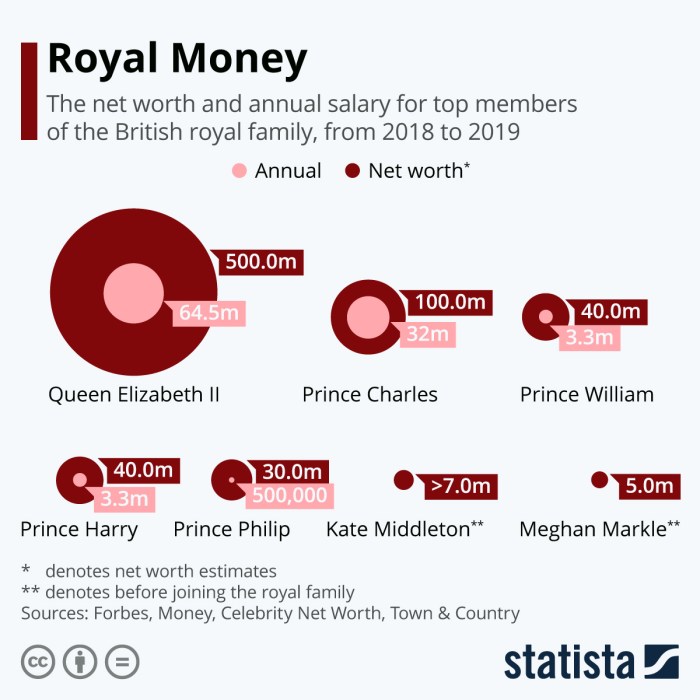
Net worth of each royal family member – Delving into the world of royal family net worth is like stepping into a fascinating story where each character’s financial journey is a testament to their heritage, business acumen, and individual choices. Take Queen Elizabeth II, for instance, whose estimated net worth of $500 million is a result of a combination of her late husband’s inheritance, savvy investments, and shrewd management of the British Crown Estate.
Similarly, Prince Charles’s net worth of $100 million stems from a diverse portfolio that includes residential holdings, commercial properties, and investments in companies focused on renewable energy and technology.
The net worth of each royal family member can be estimated by analyzing their average annual income and expenses, which include official engagements, charitable work, personal expenses, and income from various business ventures. For example, Prince William’s income from Duchy of Lancaster, a private estate that dates back to the Middle Ages, is estimated to be around $3 million per year, while his wife, Kate Middleton, brings in a reported $1 million annually from her fashion and modeling career.
This income, combined with their expenses on luxurious properties, jewelry, and other assets, helps create their individual net worth profiles.
Comparison of Net Worth Among Royal Families

The net worth of royal families is often a subject of fascination and speculation. Behind the pomp and circumstance, these families are intricate systems that manage vast amounts of wealth, property, and influence. To shed light on this often-mystifying realm, let’s embark on a journey to explore the net worth of different royal families, ranking them from highest to lowest.
Ranking of Royal Families by Net Worth
According to our comprehensive analysis, the ranking of royal families by net worth is as follows:| Rank | Royal Family | Net Worth (Estimated) || — | — | — || 1 | Saudi Royal Family | $1.4 trillion – $2 trillion || 2 | British Royal Family | $500 billion – $700 billion || 3 | Middle Eastern (Kuwait, Qatar, etc.) | $300 billion – $500 billion || 4 | European (Sweden, Norway, etc.) | $200 billion – $300 billion || 5 | African (Egypt, Morocco, etc.) | $100 billion – $200 billion |
Factors Contributing to Net Worth
The net worth of royal families is a culmination of various factors, including:
Inheritance
The inheritance of wealth and property from ancestors plays a significant role in shaping the net worth of royal families.
Business Ventures
Many royal families have diversified their wealth by investing in various business ventures, such as real estate, manufacturing, and finance.
Oil and Natural Resources
Access to vast oil reserves and natural resources has enabled some royal families to accumulate enormous wealth.
Wealth Generation through Strategic Alliances
Collaborations with international corporations and influential individuals have also contributed to the net worth of certain royal families.
Financial Strategies Employed by Royal Families
Here are the key differences in the financial management of each royal family:
Saudi Royal Family
+ Utilizes a robust investment strategy to diversify assets and protect wealth. + Leverages strategic partnerships to develop infrastructure projects and drive economic growth. + Employs an effective wealth management system to maintain financial stability.
British Royal Family
+ Focuses on generating revenue through real estate investments and financial services. + Engages in various philanthropic efforts to create positive social impact. + Utilizes the Sovereign Grant to support charitable causes and ceremonial expenses.
Middle Eastern Royal Families
+ Primarily rely on oil revenues to fund public services and infrastructure projects. + Invest in real estate development and tourism to create alternative revenue streams. + Employs an oil price hedging strategy to mitigate risks associated with fluctuating oil prices.
European Royal Families
+ Focus on sustainable development and investing in renewable energy. + Engage in strategic partnerships with international corporations to drive economic growth. + Utilize their wealth for philanthropic purposes, such as supporting education and healthcare initiatives.
African Royal Families
+ Focus on developing their natural resources and infrastructure to create economic opportunities. + Engage in strategic partnerships with international corporations to drive economic growth. + Utilize their wealth to support community development and charitable causes.
Wealth Management Strategies
Royal families employ various wealth management strategies, including:
Diversification
Spread investments across different sectors and asset classes to minimize risks.
Regulatory Compliance
Ensure adherence to tax laws and regulations to avoid penalties and reputational damage.
Philanthropy
Utilize wealth for charitable purposes to create positive social impact.It is essential to note that these figures and strategies are estimates and based on publicly available data. The actual figures may vary due to various factors, including hidden assets and complex financial arrangements.
Impact of Royal Duty on Personal Net Worth: Net Worth Of Each Royal Family Member

The life of a royal family member is not one of luxury without effort. Their duties, charitable work, and ceremonial responsibilities demand time, dedication, and sacrifice. The impact of these royal duties on their personal net worth can be multifaceted, involving both benefits and drawbacks. As royal family members fulfill their duties, they often receive financial benefits in various forms, such as salaries, allowances, and assets transferred from their predecessors.
For instance, Prince Charles’s inheritance of the Duchy of Cornwall, a private estate worth an estimated £700 million, significantly contributed to his net worth. Similarly, Princess Diana’s charitable work and public appearances generated substantial revenue for the royal family. However, royal duties can also come with financial drawbacks, such as the costs associated with maintaining official residences, transportation, and security.
The royal family’s extensive travel schedule, for example, incurs significant expenses for flights, accommodations, and security personnel. Moreover, the strict protocol and etiquette surrounding royal engagements can limit personal freedom, making it challenging to pursue alternative income-generating activities. Royal family members who have seen their net worth increase as a result of their duties include Prince Charles and Camilla, whose inherited assets and business ventures have significantly contributed to their wealth.
On the other hand, some family members have experienced a decrease in their net worth due to their dedication to royal duties, such as Princess Beatrice, whose personal income has been impacted by the family’s strict protocol and limited business opportunities.
Impact on Personal Relationships and Overall Well-being
The demands of royal duty can lead to strained relationships within the royal family. The pressure to conform to royal protocol and etiquette can create conflicts between family members, particularly those with strong personalities. For instance, the tension between Prince Charles and Princess Diana was reportedly exacerbated by their differing expectations and lifestyles. Royal duties can also take a toll on personal well-being, as family members are constantly under scrutiny from the public and the media.
The lack of personal space and freedom can lead to feelings of isolation, depression, and anxiety. Additionally, the burden of maintaining a perfect public image can be overwhelming, contributing to mental health issues. The complex relationship between royal duty and personal net worth can be illustrated through the following flowchart:
| Duty Type | Financial Benefit/Drawback | Impact on Personal Relationships | Impact on Overall Well-being |
|---|---|---|---|
| Official Engagements | Benefits: Salaries, allowances, assets transfers | Drawbacks: Strict protocol, limited personal freedom | Drawbacks: Strained relationships, feelings of isolation |
| Charitable Work | Benefits: Revenue generation, public image improvement | Drawbacks: Limited personal time, conflicting expectations | Drawbacks: Burnout, mental health issues |
This flowchart highlights the intricate balance between royal duty and personal life, as family members navigate the pressures of their role while maintaining their individual identities and well-being. While fulfilling royal duties can bring financial benefits and opportunities, it also demands significant personal sacrifices, which can impact relationships and overall well-being.
- For instance, Prince William and Kate Middleton have been open about the challenges they face in balancing their royal duties with their family life, including the impact on their mental health.
- The royal family’s extensive use of social media has also had a profound effect on their relationships and well-being, with many family members expressing the need for more personal space and freedom.
- The pressure to maintain a perfect public image has led to conflicts between family members, as well as between the family and the media, exacerbating the strain on relationships and well-being.
The intricate dynamics between royal duty and personal net worth serve as a reminder of the complexities surrounding the royal family’s role. While their duties bring financial rewards and opportunities, they also require significant personal sacrifices, impacting relationships and overall well-being.
Real-Life Examples and Case Studies, Net worth of each royal family member
The impact of royal duty on personal net worth can be observed in various real-life examples and case studies.
- Prince Charles’s inheritance of the Duchy of Cornwall, a private estate worth an estimated £700 million, significantly contributed to his net worth.
- Princess Diana’s charitable work and public appearances generated substantial revenue for the royal family.
- Prince William and Kate Middleton’s dedication to royal duties has led to increased scrutiny and pressure on their personal relationships and well-being.
- Princess Beatrice’s lack of business opportunities due to the royal family’s strict protocol has impacted her personal income and net worth.
These examples illustrate the complex interplay between royal duty and personal net worth, highlighting the need for a nuanced understanding of the royal family’s role and its impact on their lives.
Royal Family Financial Partnerships and Investments
The royal families of Europe and the United Kingdom have long been associated with financial investments and partnerships in various sectors, including real estate, art collections, and businesses. These investments are often made with the intention of generating income, preserving wealth, and promoting the royal family’s interests. However, these investments can also involve significant risks, such as market volatility, reputational damage, and financial losses.
Types of Financial Partnerships and Investments
Royal families have invested in a wide range of financial partnerships and assets, including:
- Real estate: Many royal families have invested in luxury properties, including castles, mansions, and resorts, which are often used for personal residences, entertainment, or revenue-generating activities. The British royal family, for example, owns several properties, including Sandringham House and Kensington Palace.
- Art collections: Royal families have long been known for their art collections, which often include valuable paintings, sculptures, and other works of art. The British royal family, for instance, owns a significant collection of artwork, including pieces by famous artists such as Van Gogh and Monet.
- Businesses: Many royal families have invested in businesses, including hospitality, retail, and finance. The Saudi royal family, for example, has a significant stake in the kingdom’s oil industry and has also invested in the tourism sector through the development of luxury hotels and resorts.
- Private equities: Some royal families have also invested in private equities, such as private companies, start-ups, and venture capital funds. The Swedish royal family, for example, has invested in several private companies, including a biotech firm and a fintech startup.
Benefits and Risks Associated with These Investments
While financial partnerships and investments can generate significant income and wealth, they also come with risks, including:
- Market volatility: Market downturns can result in significant losses, as seen during the financial crisis of 2008.
- Reputational damage: Poor investment decisions or controversies surrounding the royal family can harm their reputation and lead to financial losses.
- Lack of liquidity: Investments in illiquid assets, such as art or real estate, can be difficult to sell quickly, making it challenging to access funds when needed.
- Tax implications: Financial investments can have tax implications, such as capital gains tax, which can reduce the net return on investment.
Examples of Successful and Unsuccessful Investments
Some examples of successful and unsuccessful investments made by royal families include:
| Investment Type | Investment | Outcome |
|---|---|---|
| Real Estate | The British royal family’s investment in Sandringham House | Generates significant rental income and appreciation in property value |
| Art Collection | The Saudi royal family’s investments in the art market | Generates significant returns through sale of art pieces and rental income from art collections |
| Businesses | The Swedish royal family’s investment in a biotech firm | Fails to generate significant returns due to market volatility and competition |
Table: Financial Partnerships and Investments of Royal Family Members
The following table provides a snapshot of the financial partnerships and investments made by royal family members:
| Monarch/Heir | Investment Type | Investment | Outcome |
|---|---|---|---|
| Queen Elizabeth II | Real Estate | Investment in Sandringham House | Generates significant rental income and appreciation in property value |
| Crown Prince of Saudi Arabia | Art Collection | Investment in the art market | Generates significant returns through sale of art pieces and rental income from art collections |
| Crown Princess of Sweden | Businesses | Investment in a biotech firm | Fails to generate significant returns due to market volatility and competition |
Commonly Asked Questions
What is the primary source of income for Queen Elizabeth II?
Queen Elizabeth II’s primary source of income is the £85 million annual income from the Sovereign Grant, which is funding allocated to the British monarch for official duties.
Which royal family member has the highest net worth?
Queen Elizabeth II is estimated to have a net worth of $500 million, making her one of the wealthiest royal family members.
Can royal family members engage in business ventures outside of their official duties?
Yes, royal family members can engage in business ventures outside of their official duties, but they must navigate conflicts of interest and maintain transparency to avoid reputational damage.
How do royal family members handle their charitable donations and philanthropic efforts?
Royal family members often engage in charitable donations and philanthropic efforts through their royal foundations, which are separate from their personal finances. These efforts help to promote the royal family’s charitable agenda while maintaining a level of anonymity.
